 Image: NASA, ESA, CSA, and STScI
What the James Webb Space Telescope has found so far
The James Webb Space Telescope left Earth on 25 December 2021 and released its first science images on 12 July 2022. By October 2026 it has been observing for more than four years. Its 6.5 m mirror, built from 18 gold-coated beryllium segments, collects over five times as much light as Hubble's, and its instruments cover infrared wavelengths between 0.6 and about 28 micrometers. The telescope orbits a point 1.5 million km from Earth, behind a sunshield the size of a tennis court that keeps the optics below 50 K. NASA's mission page has the technical details.
The first galaxies are brighter than predicted
Webb was built for the infrared because the expansion of the universe stretches the light of early galaxies. Hydrogen's Lyman alpha line leaves a galaxy at 121.6 nanometers in the ultraviolet. At a redshift of 14 it arrives near 1.8 micrometers in the infrared, beyond the reach of Hubble's cameras.
Before Webb, the most distant known galaxy had a redshift near 11. In 2024 the JADES survey reported JADES-GS-z14-0, and in 2025 the ALMA radio array pinned its redshift at 14.18 by detecting oxygen in it. We see this galaxy less than 300 million years after the Big Bang. Oxygen is made in stars, so at least one generation of stars had already lived and died there.
The current record holder is MoM-z14, announced in May 2025 and published after peer review in January 2026. Its redshift is 14.44, which corresponds to 280 million years after the Big Bang. As of October 2026 no galaxy with a confirmed spectrum lies farther away. The authors estimate that galaxies this bright are more than a hundred times as common at that epoch as models predicted before launch.
Headlines about a broken Big Bang went too far. The age and expansion history of the universe are unchanged by these galaxies. The part that needs repair is the description of how quickly gas turned into stars during the first few hundred million years. Bursts of star formation, a lack of dust and a larger share of massive stars are all being tested as explanations.
Little red dots and early black holes
Webb images contain a population nobody had planned for: compact, very red sources, most of them seen between about 600 million and 1.5 billion years after the Big Bang. Astronomers call them little red dots. Many show broad hydrogen emission lines, the signature of gas moving at thousands of km/s, and gas moves that fast around a massive black hole.
The reading that gained the most support in 2025 and 2026 is that these are young supermassive black holes wrapped in dense gas, which reddens the light and hides the X-rays such objects normally emit. Some researchers describe the extreme cases as black hole stars, a black hole inside a thick, glowing envelope. The question is still argued in the journals. Webb has also found a black hole of more than a million solar masses in the galaxy GN-z11, about 430 million years after the Big Bang. How black holes grew that large that early has no agreed answer, and the black hole article explains why growth takes time.
Atmospheres of other worlds
When a planet passes in front of its star, a little starlight filters through the planet's atmosphere, and molecules there absorb specific wavelengths. Webb measures that absorption. In August 2022 it made the first clear detection of carbon dioxide in an exoplanet atmosphere, on the hot Saturn-mass planet WASP-39 b, about 700 light years away. The same planet showed sulfur dioxide, which is produced when starlight breaks up other molecules. That was the first evidence of photochemistry on a planet outside the solar system.
Rocky planets are much harder. The TRAPPIST-1 system, 40 light years away, has seven Earth-sized planets. Webb measured the heat from the two innermost ones in 2023 and found dayside temperatures near 500 K and 380 K, which fit bare rock or at most a thin atmosphere. For TRAPPIST-1 e, which lies in the habitable zone, the first four transits (published in 2025) could not decide between a nitrogen-rich atmosphere and no atmosphere at all, mainly because spots on the star contaminate the signal. More transits are being collected.
Then there is K2-18 b, a planet of 8.6 Earth masses, 124 light years away. Webb found methane in its atmosphere in 2023. In April 2025 one team reported dimethyl sulfide, a gas that on Earth comes from living organisms, at a significance of 3 sigma. Independent analyses of the same data found the evidence insufficient. A 3 sigma signal in a noisy spectrum disappears often enough that astronomers ask for 5 sigma before they speak of a detection, and so far Webb has found no sign of life.
Stars and the solar system
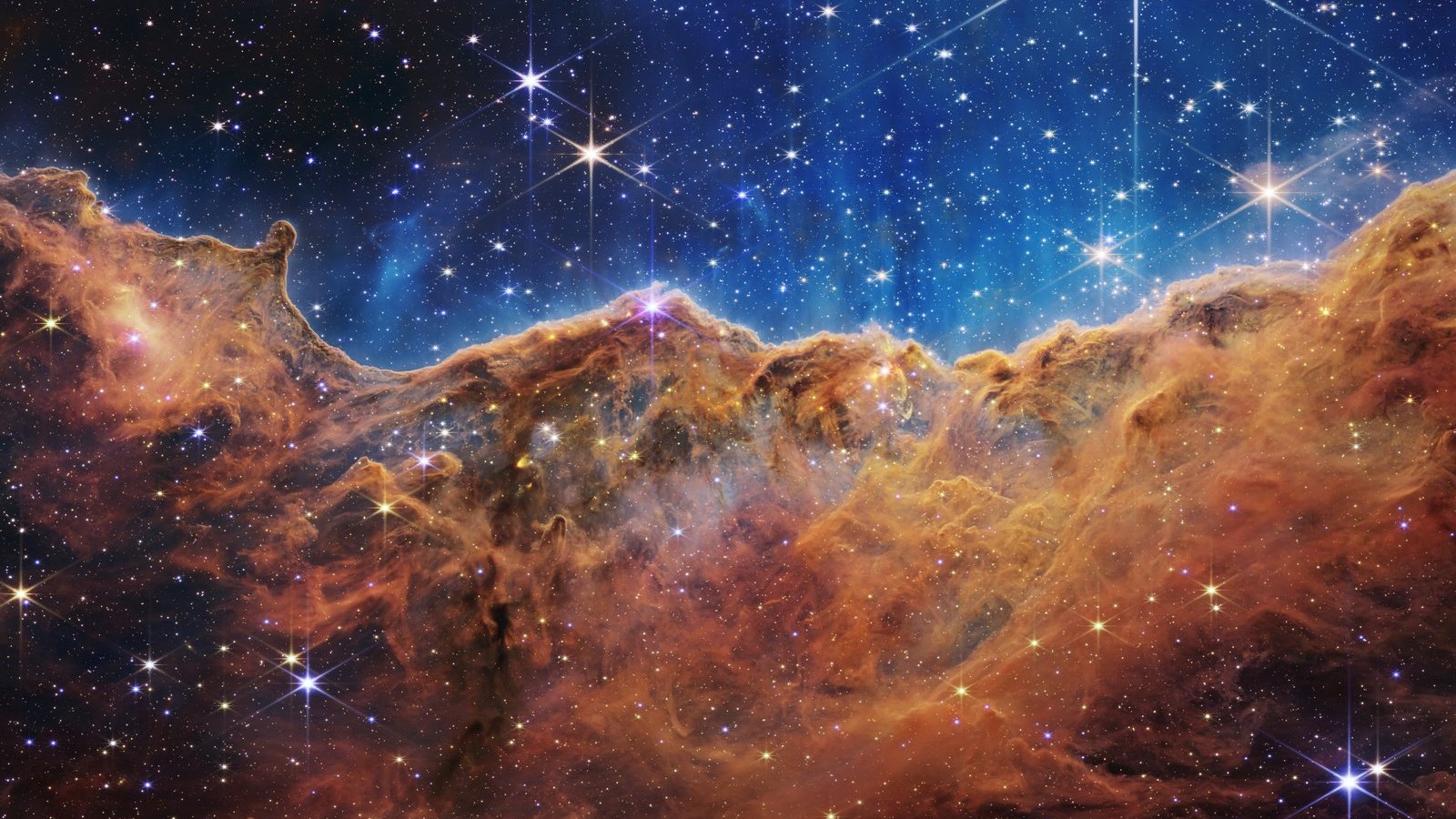
The cover image of this article shows the Cosmic Cliffs, the edge of a cavity in the Carina Nebula about 7,600 light years away. In infrared light Webb sees through much of the dust, and hundreds of newborn stars and their jets appear that were hidden in Hubble's view.
Webb also looked at the end of a star's life. Supernova 1987A exploded in the Large Magellanic Cloud, and for 37 years nobody could find the compact object it should have left. In February 2024 Webb's spectrographs detected highly ionized argon at the center of the debris, which needs a hot, young neutron star as its energy source. The story of how stars get there is in the life cycle of a star.
Closer to home, Webb imaged a plume of water vapor from Saturn's moon Enceladus that extends more than 9,600 km, about twenty times the size of the moon itself. In images taken in February 2025 it found a previously unknown moon of Uranus, roughly 10 km across and now the 29th known.
What Webb has not settled
Two methods of measuring the expansion rate of the universe disagree by about 9 percent. One suspicion was that Hubble's photometry of Cepheid stars in crowded galaxies was biased. Webb's sharper infrared images showed in 2024 that the Hubble measurements were right, which removed that explanation. A second team used Webb data on red giant stars and obtained an intermediate value. The disagreement remains open, and it has its own article.
The very first stars, made only of hydrogen and helium, have not been confirmed either. The strongest candidate so far is LAP1-B, a tiny galaxy magnified by a foreground cluster, whose gas holds less than one percent of the Sun's share of oxygen. As of 2026 astronomers still treat it as a candidate.
NASA estimated after launch that the telescope has enough propellant for more than 20 years of operation, so this list is an interim report.
The A&A Masterclass uses Webb results where the physics is taught. Unit 4 explains how the telescope and its detectors work, Unit 11 covers transmission spectroscopy of exoplanet atmospheres, and Unit 16 deals with the first galaxies and cosmic dawn. See the curriculum for all units.