

Telescopes and Observational Techniques
This unit explains how telescopes collect light and what limits the detail they can show: the aperture, diffraction, the atmosphere and the detector. Students work out the signal to noise ratio of a real observation and see how adaptive optics, interferometers and space observatories get around the limits of a single mirror on the ground.
1 Collecting light
A star of visual magnitude 25 sends about one photon per second through each square meter at the Earth. A telescope has two jobs with such a source. It must collect as many of those photons as it can, and it must keep light from neighboring directions apart, so that two stars close together on the sky end up as two spots on the detector. The first job depends on the area of the aperture, the second on its diameter and on the wavelength.
1.1 Refractors and reflectors
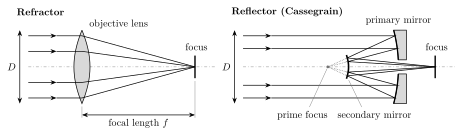
A refractor uses a lens as its objective. Light travels more slowly in glass than in air, so the curved surfaces of the lens bend parallel rays from a distant star toward a common point, the focus, at a distance called the focal length \(f\) (Figure 1). Galileo’s telescopes of 1609 worked this way. The design does not scale well. The refractive index of glass depends on wavelength, so blue light comes to a focus closer to the lens than red light and every star gets a colored fringe, a fault called chromatic aberration. A lens can also be held only at its rim, and a large one sags under its own weight. The largest refractor ever used for research, the 1.02 m telescope of Yerkes Observatory in Wisconsin, dates from 1897.
A reflector uses a curved mirror instead. Reflection works the same way at all wavelengths, and a mirror can be supported across its whole back. A mirror shaped as a paraboloid sends all rays that arrive parallel to its axis to one point in front of it. Since that point lies in the incoming beam, most designs add a small secondary mirror. In the Cassegrain layout a convex secondary sends the light back through a hole in the primary to a focus behind it, where heavy instruments can be mounted.
Single glass mirrors have been cast up to 8.4 m across. Larger ones are built from segments: each Keck telescope in Hawaii has 36 hexagonal segments that act as one 10 m mirror, and the Extremely Large Telescope under construction in Chile is designed to combine 798 segments into a primary 39 m across.
1.2 Light gathering power and image scale
The number of photons that a telescope collects per second from a given source is proportional to the area of its aperture, \(\pi D^2/4\) for a diameter \(D\).
A 10 m mirror collects \((10\unit{m}/7\unit{mm})^2 = 2\times10^{6}\) times more light than the dark-adapted pupil of the eye, a gain of 15.8 magnitudes. A detector adds to this by storing light for hours, while the eye starts afresh every tenth of a second.
The focal length sets the size of the image. Two stars separated by a small angle \(\theta\) (in radians) form images a distance \(s = f\theta\) apart in the focal plane, by the small-angle formula of Unit 1. With \(f = 10.3\unit{m}\), the value for the Rubin Observatory telescope of Section 7, stars one arcsecond apart (\(1/206\,265\unit{rad}\)) are separated by \(50\unit{\mu m}\) on the detector. The quotient \(f/D\) is the focal ratio, written f/2 or f/15. A “fast” telescope with a small focal ratio gives small, bright images over a wide field, and a “slow” one spreads a small patch of sky over the whole detector.