

The Solar System
This unit takes stock of the solar system and explains how it formed 4.567 billion years ago from a disk of gas and dust. You calculate planetary temperatures, the Roche limit and the positions of orbital resonances, and you meet the evidence that the giant planets changed their orbits early on and rearranged everything else.
1 Inventory and scale
The Sun holds 99.86% of the mass of the solar system. Jupiter has 71% of what is left, and the other seven planets, a few hundred moons and more than a million catalogued asteroids and comets share the remainder. Angular momentum is distributed the other way round: the orbital motion of Jupiter alone carries about 60% of it, and the spin of the Sun less than 1%. A theory of formation has to explain both.
The planets come in two kinds (Table 1). Mercury, Venus, Earth and Mars are small and dense, made of rock and iron. Jupiter and Saturn consist mostly of hydrogen and helium, Uranus and Neptune mostly of water, ammonia and methane under a hydrogen envelope. All eight move around the Sun in the same direction, on nearly circular orbits within a few degrees of a common plane (Unit 2).
| Planet | \(a\) (au) | Mass (\(\Mearth\)) | Radius (\(\Rearth\)) | Density (g cm\(^{-3}\)) |
|---|---|---|---|---|
| Mercury | 0.387 | 0.0553 | 0.383 | 5.43 |
| Venus | 0.723 | 0.815 | 0.950 | 5.24 |
| Earth | 1.00 | 1.00 | 1.00 | 5.51 |
| Mars | 1.52 | 0.107 | 0.532 | 3.93 |
| Jupiter | 5.20 | 318 | 10.97 | 1.33 |
| Saturn | 9.58 | 95.2 | 9.14 | 0.687 |
| Uranus | 19.2 | 14.5 | 3.98 | 1.27 |
| Neptune | 30.1 | 17.1 | 3.86 | 1.64 |
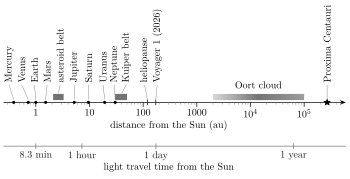
Everything else is debris. The asteroid belt lies between 2.1 and 3.3 au, the Kuiper belt of icy bodies between 30 and 50 au, and the Oort cloud of comets reaches out to about 100 000 au, more than a third of the way to the nearest star (Figure 1). The solar wind blows a bubble into the interstellar gas, and Voyager 1 crossed its edge, the heliopause, in 2012 at 122 au. That spacecraft, launched in 1977, is about 172 au away in late 2026, and its radio signal needs almost a full day to reach us.
2 Formation from the solar nebula
The planets orbit in one plane and in one direction, which points to a rotating disk as their birthplace. Rock sits close to the Sun and ice and gas far out, so the disk was hot inside and cold outside. And the oldest solids in meteorites share a single age, 4.567 billion years, to within a few hundred thousand years.
2.1 Disk and frost line
About 4.57 billion years ago a dense core of a molecular cloud collapsed under its own gravity (Unit 7). Because angular momentum is conserved, the slowly rotating gas spun up as it fell inward and settled into a flat disk about 100 au in radius around the young Sun, the solar nebula. By mass it was 98.5% hydrogen and helium and 1.5% everything else, part of it in dust grains less than a micrometer across. Such disks are observed around young stars (Unit 11), and they are short-lived: in star clusters older than about 5 million years only a small minority of stars still has one. Giant planets must collect their gas within that time.
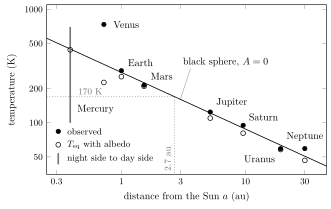
Temperature decides what can be solid. Close to the young Sun only metals and silicates existed as grains. Water stays vapor until the temperature falls below about 170 K, and the distance at which that happens is the frost line. A simple estimate uses the temperature of a black grain in sunlight, \(T = 278\unit{K}\,(a/1\unit{au})^{-1/2}\), which Section 3 derives. Setting \(T = 170\unit{K}\) gives \(a = (278/170)^2\unit{au} \approx 2.7\unit{au}\). Detailed disk models put the line anywhere between 2 and 5 au. The simple value lands in the middle of the asteroid belt, and that fits: asteroids of the inner belt are dry rock, and those of the outer belt contain up to 10% water. Beyond the frost line water ice adds two to three times the mass available in rock and metal, and solid cores grow bigger.
2.2 Growth of solids into planets
Dust grains collide gently and stick, and within a few thousand years they grow to pebbles. Then growth stalls. Pebbles bounce off each other, and bodies around a meter in size feel a headwind, because the gas is partly supported by its own pressure and orbits slightly slower than a solid body does. A meter-sized rock at 1 au would spiral into the Sun in about a century. Current models get around the barrier collectively: drag concentrates pebbles into dense clumps, and the gravity of a clump pulls it together into a planetesimal some 100 km across. The Kuiper belt object Arrokoth, which the New Horizons probe passed in 2019, looks like a product of this process: two lobes, together 36 km long, that touched at walking speed and merged without damage.
The largest planetesimals have the longest gravitational reach and grow fastest. In under a million years the inner disk is dominated by a few dozen planetary embryos with masses between those of the Moon and Mars, which merge in giant collisions over the next tens of millions of years. Beyond the frost line the embryos were larger. A core of about \(10\,\Mearth\) holds on to hydrogen and helium, and once the envelope is as massive as the core the inflow runs away. Jupiter and Saturn grew this way, by core accretion. Uranus and Neptune were slower and had collected only one or two Earth masses of gas when the disk dispersed.
2.3 Radiometric ages
The ages in this unit come from radioactive decay. A radioactive parent nuclide decays into a stable daughter with a fixed half-life \(t_{1/2}\). Of \(N_0\) parent atoms, \(P = N_0\,2^{-t/t_{1/2}}\) remain after a time \(t\), and \(D = N_0 - P\) have turned into daughters. Dividing the two gives \(D/P = 2^{t/t_{1/2}} - 1\), and a logarithm (Unit 1) solves for the time.
The oldest dated solids of all are calcium-aluminum-rich inclusions (CAIs), millimeter-sized grains in primitive meteorites that were the first minerals to condense from the hot gas. The two decay chains of uranium to lead give them an age of \(4567.3 \pm 0.2\) million years, which defines the age of the solar system. By the zircon above, the Earth had a solid crust 170 million years later.
3 Terrestrial planets
3.1 Interiors and surfaces
The mean density of a planet is the first clue to its interior. Surface rock has about 3 g cm\(^{-3}\) and iron 7.9, so the Earth’s 5.51 requires a large iron core. Seismic waves map it: a liquid outer core of radius 3480 km, 55% of the Earth’s radius, with a solid inner core at its center. Iron separated from rock while the young planet was molten, a process called differentiation. Mercury is nearly as dense as the Earth although it is too small to be compressed much, so it must be mostly iron; its core spans about 83% of its radius. On Mars the seismometer of the InSight lander found a liquid core about half the planet’s radius in size.
Surfaces tell time through craters. An old surface has collected more impacts than a young one, and Apollo samples, dated with the method of Section 2, calibrate the count. The lunar highlands are more than 4 billion years old. Venus has about 940 craters spread evenly over the planet, so its entire surface was renewed by volcanism within roughly the last 500 million years. The Earth recycles its ocean floor by plate tectonics in less than 200 million years. Mars has old cratered highlands with dry river valleys, cut when liquid water flowed under a thicker atmosphere. Small planets cool fastest, and the Moon and Mercury have been geologically quiet for billions of years.
3.2 Equilibrium temperature and greenhouse effect
A planet absorbs sunlight and radiates infrared, and its temperature settles where the two balance.
Figure 2 compares the formula with measurements. Mercury has no atmosphere and rotates slowly, so its day side reaches 700 K while the night side drops to 100 K. The giant planets are warmer than sunlight alone would make them (Section 4). And the surface of Venus is 500 K hotter than its equilibrium temperature, because of the greenhouse effect. An atmosphere lets most visible sunlight through to the ground. The ground radiates in the infrared, near a wavelength of 10 \(\mu\)m by Wien’s law (Unit 3), and there molecules such as CO\(_2\) and H\(_2\)O absorb strongly. The radiation that finally escapes to space comes from a high, cold layer of air, and it is this layer that sits at \(T_{\mathrm{eq}}\). The ground beneath has to be warmer.
Water made the difference between the two planets. Venus receives 1.9 times as much sunlight as the Earth, and an early ocean there would have evaporated. Without liquid water, CO\(_2\) cannot be bound into carbonate rock, which is where the Earth keeps a comparable amount.
Whether a planet keeps a gas at all is a contest between thermal motion and gravity. Molecules of mass \(m\) in a gas of temperature \(T\) move at a typical speed \(v_{\mathrm{th}} = \sqrt{3kT/m}\), where \(k\) is the Boltzmann constant. Some are much faster, so a planet holds a gas for billions of years only if its escape velocity (Unit 2) is more than about six times \(v_{\mathrm{th}}\). In the Earth’s upper atmosphere, at about 1000 K, six times \(v_{\mathrm{th}}\) is \(21\unit{km\,s^{-1}}\) for hydrogen molecules and \(5.7\unit{km\,s^{-1}}\) for nitrogen. The escape velocity is \(11.2\unit{km\,s^{-1}}\): hydrogen leaves and nitrogen stays. The Moon, with \(2.4\unit{km\,s^{-1}}\), keeps nothing, and Jupiter, with \(60\unit{km\,s^{-1}}\), keeps everything.
4 Giant planets, rings and moons
4.1 Gas giants and ice giants
Jupiter has 318 Earth masses, nearly the composition of the Sun, and no surface. Below the clouds the hydrogen gets steadily denser and turns into a liquid without a sharp boundary. Above a pressure of about a million bar, reached some 15% of the way to the center, the electrons move freely and the fluid becomes metallic hydrogen. Convection in this conductor drives a magnetic field more than ten times stronger than the Earth’s. Gravity measurements by the Juno orbiter show that the heavy elements, 10 to 25 \(\Mearth\) of them, are spread through the inner half of the radius; a compact core with a sharp edge does not fit the data.
Jupiter’s effective temperature, measured from its infrared emission, is 124 K, while the equilibrium formula predicts 110 K. Power goes as \(T^4\), so the planet emits \((124/110)^4 \approx 1.6\) times what it absorbs. The surplus is heat left from formation, released as the planet slowly cools and contracts.
Uranus and Neptune are a different kind of planet. Their densities require interiors mostly of water, ammonia and methane, with hydrogen and helium limited to an envelope of at most 20% of the mass. These compounds arrived frozen in planetesimals, hence the name ice giants, although inside the planets they form a hot, dense fluid.
4.2 Rings and the Roche limit
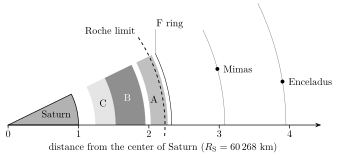
Saturn’s main rings extend between 74 500 and 136 800 km from the center of the planet and are in most places about 10 m thick. A sheet of paper with the same proportions would be nearly 3 km wide. The rings consist of lumps of water ice, mostly a centimeter to a few meters in size, each on its own Kepler orbit. Their age is disputed: the clean ice suggests a few hundred million years, since infalling dust should have darkened it, yet some models let the rings shed the dust and last since Saturn formed. Rings lie close to their planets and large moons farther out, and the reason is tides.
For Saturn (\(R = 60\,268\unit{km}\), \(\rho_M = 0.687\unit{g\,cm^{-3}}\)) and lumps of solid ice (\(\rho_m = 0.9\unit{g\,cm^{-3}}\)) the formula gives \(d_{\mathrm{R}} = 2.44\times60\,268\unit{km}\times0.914 = 134\,000\unit{km}\). The outer edge of the A ring lies at 136 800 km (Figure 3). Inside this distance the ice cannot assemble into a moon. Outside it can, and Mimas orbits at 185 500 km. The limit applies only to bodies held together by gravity. Satellites and astronauts orbit far inside the Earth’s Roche limit, kept in one piece by chemical bonds. A loose pile of rubble has no such protection: comet Shoemaker-Levy 9 passed Jupiter at 1.3 planetary radii in 1992 and broke into 21 pieces, which hit the planet two years later.
4.3 Moons with oceans
Tides also heat. Io, the innermost large moon of Jupiter, completes four orbits while Europa completes two and Ganymede one. This resonance keeps Io’s orbit slightly eccentric, so its tidal bulge rises and falls during every orbit of 1.77 days, and the flexing feeds over 400 active volcanoes. Europa gets a smaller dose of the same heating, enough to keep water liquid: under an ice shell some 20 km thick lies a salty ocean with roughly twice the water of all the Earth’s oceans. The evidence is magnetic. Jupiter’s tilted field sweeps past Europa every 11 hours, and the Galileo orbiter measured an induced field in response, which requires a global conducting layer close to the surface.
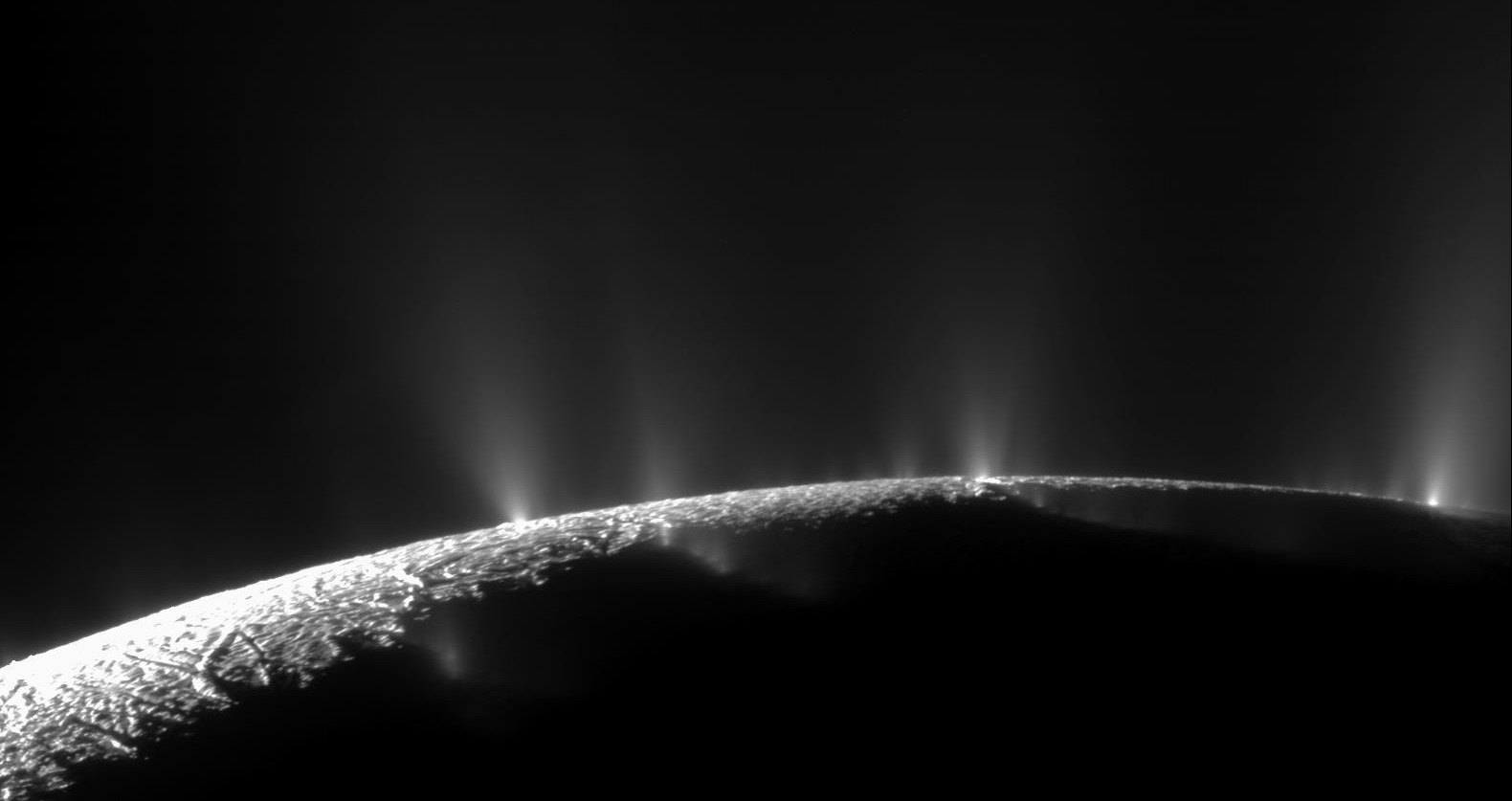
Saturn’s moon Enceladus, only 504 km across, should be frozen solid. In 2005 Cassini found jets of water vapor and ice grains shooting out of fractures near its south pole (Figure 4). The spacecraft flew through the plume and detected salts and organic molecules, along with silica and molecular hydrogen, which form where hot water meets rock. A slight wobble in the moon’s rotation shows that the ice shell floats on a global ocean. The heating again comes from a resonance, here with the moon Dione. These moons offer liquid water and an energy source far outside the zone where sunlight keeps water liquid. NASA’s Europa Clipper, launched in 2024, arrives at Jupiter in 2030 to take a closer look.
5 Small bodies and resonances
5.1 Asteroids and the Kirkwood gaps
The asteroid belt contains little: all its bodies together have 3% of the mass of the Moon, and Ceres, 940 km across, has more than a third of that. Asteroids of the inner belt are mostly stony (S-type), those of the outer belt dark and rich in carbon (C-type). Meteorites are free samples of both, and the OSIRIS-REx mission went to the source: it returned 121.6 g of the C-type asteroid Bennu in 2023, and the grains contain clay minerals, salts left by evaporated brine and 14 of the 20 amino acids used in proteins.
A histogram of asteroid orbits (Figure 5) shows gaps, found by Daniel Kirkwood in 1866. They lie where the orbital period would be a simple fraction of Jupiter’s. Kepler’s third law, \(P^2 \propto a^3\) (Unit 2), converts a ratio of periods into a distance.
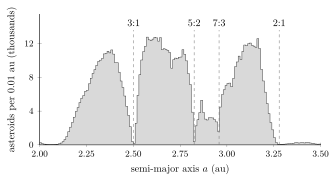
A resonance empties an orbit because the encounters repeat. An asteroid at 2.50 au meets Jupiter at the same points of its orbit again and again, so the small tugs add up, while elsewhere they average out. Its eccentricity grows erratically until, after a million years or so, the orbit crosses that of Mars or the Earth and a close encounter removes it. A resonance can also protect. Pluto is closer to the Sun than Neptune for 20 years of each 248-year orbit, and the 3:2 timing guarantees that Neptune is far away whenever Pluto crosses.
5.2 Comets, the Kuiper belt and the Oort cloud
Beyond Neptune lies the Kuiper belt, a disk of icy bodies between 30 and about 50 au. Pluto, found in 1930, was its first known member, and several thousand are catalogued now. When Eris, as large as Pluto and 27% more massive, turned up in 2005, the International Astronomical Union had to choose between many more planets and a definition that excludes Pluto. It chose the definition: a planet must have cleared its orbital zone. The whole belt today contains about 2% of an Earth mass, while models that grow bodies as large as Pluto need 20 to 30 \(\Mearth\). More than 99% of the original belt has been lost, and Section 6 says where it went.
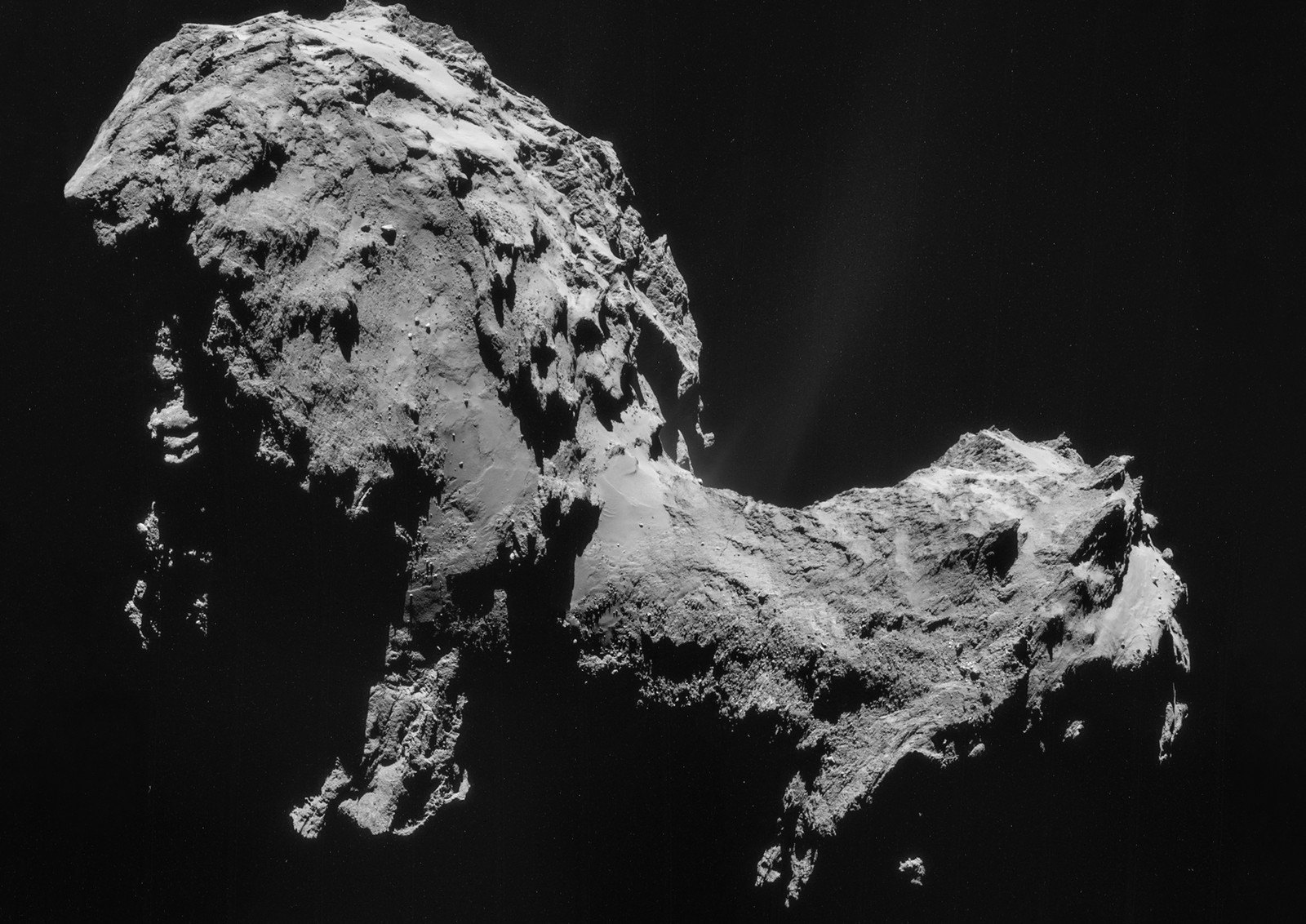
A comet is an icy body on an orbit that brings it close to the Sun. The nucleus is small, dark and porous: comet 67P/Churyumov-Gerasimenko, which the Rosetta spacecraft accompanied for two years (Figure 6), is 4 km long, reflects 6% of the light that hits it and has a density of 0.53 g cm\(^{-3}\). Inside about 3 au its water ice turns to vapor and the escaping gas drags dust along, which produces a coma and two tails, a straight one of ions blown by the solar wind and a curved one of dust pushed by sunlight. A comet is used up after roughly a thousand orbits, so the comets we see must be recent arrivals from cold storage.
There are two stores. Short-period comets orbit in the plane and direction of the planets and leak inward from the Kuiper belt. Long-period comets arrive from all directions on orbits with semi-major axes of tens of thousands of au. Jan Oort concluded in 1950 that a spherical cloud of some \(10^{11}\) to \(10^{12}\) comet nuclei surrounds the Sun out to about 100 000 au. Nobody has seen an object inside the Oort cloud; the evidence is the orbits of the comets that fall out of it. Since 2017 three objects on unbound orbits have also been caught passing through, 1I/’Oumuamua, 2I/Borisov and 3I/ATLAS: small bodies thrown out by other planetary systems.
6 Planetary migration
The belts carry the marks of planets that moved. Pluto and hundreds of other bodies sit in Neptune’s resonances on eccentric, inclined orbits, and bodies do not form on such orbits. Renu Malhotra showed in 1993 that the pattern follows if Neptune migrated outward by at least 5 au. Its resonances moved with it, swept up bodies like a snowplow and pumped up their eccentricities.
Two mechanisms move a planet. While the gas disk exists, the gravity of a planet raises spiral waves in the gas, and the pull of these waves changes its orbit, usually inward, within some \(10^5\) years. After the gas is gone, planets move by scattering leftover planetesimals. Each small body thrown outward takes angular momentum from the planet, and each one thrown inward gives some back. Neptune, Uranus and Saturn passed most of their planetesimals inward to Jupiter, which is massive enough to eject them from the solar system. Jupiter paid with a small inward shift, and the other three moved outward.
The Nice model, published in 2005 by Rodney Gomes, Harold Levison, Alessandro Morbidelli and Kleomenis Tsiganis, who worked together in Nice, turns this into the central event of solar system history. The four giant planets start close together, between 5.5 and about 17 au, with a disk of planetesimals of \(35\,\Mearth\) outside them. Slow migration eventually carries Jupiter and Saturn across their mutual 2:1 resonance. Their orbits become eccentric, Uranus and Neptune are flung outward into the disk, and within a few million years the planetesimals are scattered in all directions. The one event accounts for the present orbits of the giant planets, the capture of Jupiter’s Trojan asteroids, the resonant and scattered populations of the Kuiper belt and the loss of 99% of its mass. Part of the ejected material became the Oort cloud. Its authors first tied the instability to a spike of impacts on the Moon 3.9 billion years ago, inferred from Apollo samples. That spike is now in doubt, and later versions place the instability within the first 100 million years, often with a fifth giant planet that Jupiter ejected.
Migration in the gas phase may have shaped the inner solar system as well. Models that grow the terrestrial planets from a smooth disk of embryos get Venus and the Earth about right, and they produce a Mars five to ten times too massive. The outcome is right if the building material ended at 1 au.
The Grand Tack is a hypothesis under test. Competing models leave Jupiter where it formed and let planetesimals form only in narrow rings, one of them near 1 au. In every version the giant planets move by several au, as planets around other stars evidently did (Unit 11).