 Image: NASA, ESA, CSA, B. Robertson (UC Santa Cruz), B. Johnson (Center for Astrophysics, Harvard & Smithsonian), S. Tacchella (University of Cambridge), M. Rieke (Univ. of Arizona), D. Eisenstein (Center for Astrophysics, Harvard & Smithsonian), A. Pagan (STScI)
Why is the night sky dark? Olbers' paradox explained
The Sun covers about 1/185,000 of the sky. If the universe were infinitely large, infinitely old, unchanging and evenly filled with stars, every line of sight would sooner or later end on the surface of a star, and the entire sky would shine as brightly as the Sun's disk, day and night, which it plainly does not. The puzzle carries the name of the German astronomer Heinrich Olbers, who wrote about it in 1823, although Johannes Kepler had already used the dark sky as an argument against an infinite universe in 1610.
The argument in numbers
Picture the stars around us sorted into thin spherical shells, like the layers of an onion. A shell at distance \(r\) with thickness \(\Delta r\) has a volume of \(4\pi r^2 \Delta r\). If space holds \(n\) stars per unit volume, the shell contains \(4\pi r^2 n\,\Delta r\) stars. Each of them, with luminosity \(L\), sends us a flux of \(L/(4\pi r^2)\). Multiply the two and the distance cancels:
\[ F_{\mathrm{shell}} = n L\,\Delta r \]A shell twice as far away has stars that look four times fainter, but it holds four times as many of them. Every shell delivers the same light. With infinitely many shells the total grows without limit.
Infinite brightness is avoided only because near stars block the ones behind them. The sum stops when the sky is completely covered with stellar disks. Think of standing in a large forest: if it is deep enough, you see nothing except trunks in every horizontal direction. The sky should therefore glow like the surface of an average star, at several thousand kelvin.
Why dust does not save the day
Olbers's own solution was that thin matter between the stars absorbs the light. Astronomers have since found plenty of interstellar dust, and it does dim distant stars. As an answer to the paradox it fails, and John Herschel explained why in 1848. Dust that absorbs starlight warms up. In an eternal universe it keeps warming until it radiates as much energy as it receives, and then it glows as brightly as the stars it hides.
A universe with a birthday
The assumption that fails is the infinite age. The universe is 13.8 billion years old and light travels at a finite speed, so we can only see stars whose light has had time to arrive. Most of the shells in the argument are simply too far away to have reported in.
The numbers show how badly the paradox misses. Take about a billion stars per cubic megaparsec, a fair round figure for the universe today, and generously give each the size of the Sun. The average distance a light ray travels before it hits a stellar surface is then \(1/(n\sigma)\), where \(\sigma = \pi R_\odot^2\) is the area of the Sun's disk. The result is about \(2 \times 10^{24}\) light years. Light has traveled at most \(1.4 \times 10^{10}\) years, which is too short by a factor of more than a hundred trillion. Only a tiny fraction of our lines of sight can end on a star.
There is a second way to see it. Stars do not shine forever. To fill space with enough radiation for a bright sky, stars would have to burn for something like \(10^{24}\) years, and a star like the Sun runs out of hydrogen after \(10^{10}\). All the nuclear fuel in all the stars is far too little energy.
Curiously, the first person to guess the right answer in print was a writer. In his 1848 essay Eureka, Edgar Allan Poe suggested that the light of the most distant stars has not yet reached us. Lord Kelvin did the calculation properly in 1901.
What the expansion adds
Many books give the expansion of the universe as the explanation. Expansion does help: it stretches each light wave on its way to us, which lowers the energy of every photon, and it spreads the photons out. For starlight, though, this is the smaller effect. A calculation published in 1987 followed the light of galaxies through different model universes and found that expansion lowers the background by a factor of about two. The finite age accounts for the many powers of ten.
The sky that is bright after all
There is one case where expansion does all the work. For its first 380,000 years the universe was filled with a hot, opaque plasma. When it cooled to about 3,000 K, electrons and nuclei combined into atoms and the gas turned transparent. At that moment every direction in the sky looked like the surface of a cool red star, a true Olbers sky.
That glow is still arriving from all directions, and nothing blocks it. Since then the universe has expanded by a factor of about 1,090, and the wavelengths have stretched by the same factor. The 3,000 K glow now has a temperature of 2.725 K and peaks at a wavelength of 1.06 mm. This is the cosmic microwave background, found by Arno Penzias and Robert Wilson in 1965. Every cubic centimeter of space contains about 411 of its photons. With microwave eyes we would see a sky that is uniformly bright, as Olbers's reasoning demands.
How dark space really is
From Earth the night sky is never fully dark, because sunlight scatters off dust in the inner solar system. NASA's New Horizons probe, now far beyond Pluto and that dust, has measured the darkness directly. The result, published in 2024, is a cosmic optical background of 11.16 ± 1.65 nanowatts per square meter per steradian. Summed over the whole sky, that is about ten billion times fainter than sunlight at Earth, and it agrees with the light expected from all known galaxies added together.
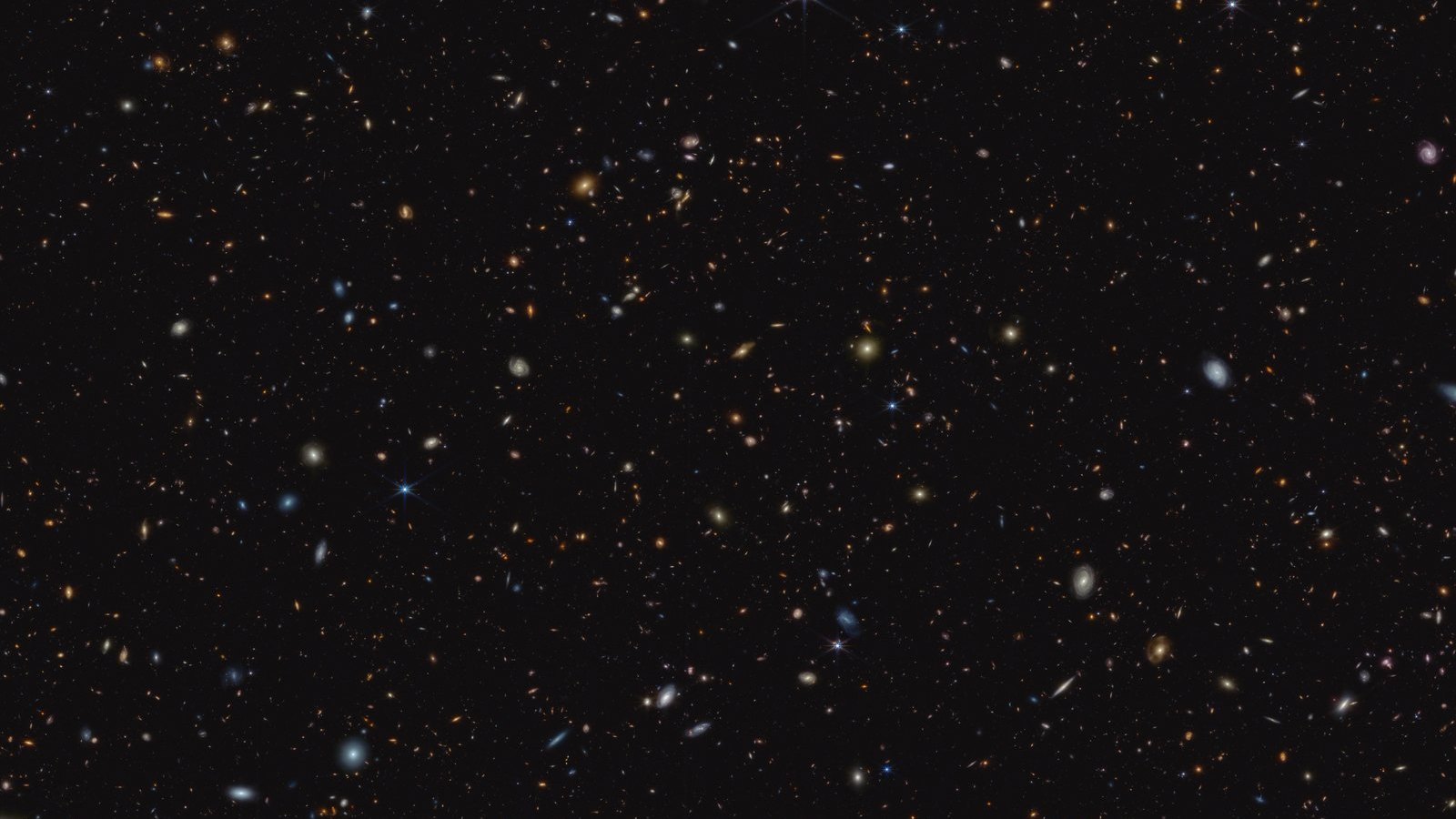
The picture at the top of this article is a deep exposure by the James Webb Space Telescope. Thousands of galaxies crowd a patch of sky smaller than the full Moon, and still most of the frame is black. The dark gaps are places where the telescope looks past the galaxies to a time before there were any.
The dark night sky is evidence that the stars have not been shining forever, and anyone can collect it by stepping outside. In the A&A Masterclass, Unit 8 gives a first account of the expanding universe and the microwave background, Unit 13 treats horizons and lookback time, and Unit 14 covers the physics of the background radiation. The details are in the curriculum.