 Image: ESO/S. Brunier for SkyPix
What you can do with an astronomy or astrophysics degree
Universities in the United States awarded 982 bachelor's degrees and 201 doctorates in astronomy in the academic year 2023 to 2024, according to the American Institute of Physics. The Bureau of Labor Statistics counts about 2,400 people in the whole country who work under the job title astronomer. Put those numbers next to each other and the conclusion is clear: most people with an astronomy degree end up doing something else. The same statistics show that they do it successfully.
What the degree trains you to do
An astronomy or astrophysics degree is a physics degree with a particular set of examples. You learn mechanics, electromagnetism, thermodynamics and quantum physics, and the mathematics that goes with them. On top of that come skills that astronomy teaches better than most subjects, because astronomers cannot run experiments on their objects and have to squeeze everything out of the data they are given.
- Programming, nearly always in Python, on real data sets.
- Statistics: fitting models, estimating uncertainties, telling a signal from noise.
- Handling large data. The Gaia catalog has 1.8 billion entries, and the Vera C. Rubin Observatory in Chile produces about 20 terabytes of images per night.
- Writing and presenting technical results to people outside your specialty.
Employers outside science pay for the first three. The fourth is rarer among graduates of technical subjects than it should be.
The research path
Becoming a professional astronomer means a doctorate. In the United States the PhD usually follows directly after the bachelor's degree and takes five to six years. In most of Europe a two year master's degree comes first and the doctorate takes three to four years. During the PhD you are paid a modest salary or stipend and do original research under a supervisor.
After the doctorate come temporary research positions called postdocs, each lasting two or three years and often in a different country. In the AIP survey of new astronomy PhDs from 2018 to 2020, two thirds took a postdoc in the year after graduating, with a median starting salary of 62,500 dollars at universities. Many people do two or three postdocs before they apply for permanent jobs as professors or as staff scientists at observatories and space agencies.
The path narrows at this point. Far fewer permanent academic positions open each year than doctorates are awarded, so many good researchers leave for other careers in their thirties. It helps to know this at the start. The pay for those who stay is respectable: the median salary of astronomers in the United States was 128,820 dollars in May 2025, and the Bureau projects 8 percent growth in the number of jobs between 2025 and 2035. Eight percent of 2,400 is about 200 jobs.
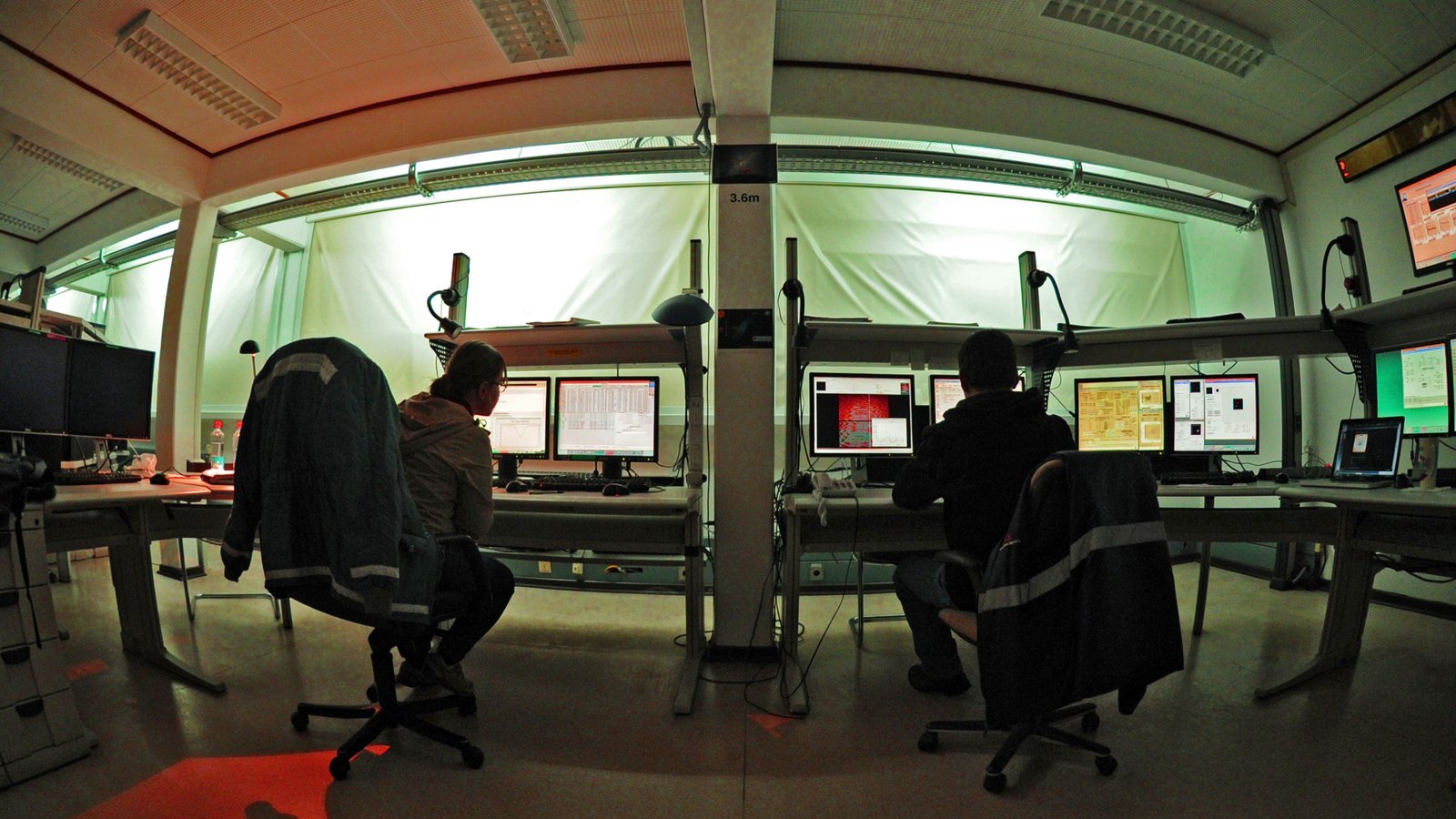
Research is not limited to universities. Observatories such as the European Southern Observatory, space agencies and national laboratories employ support astronomers, instrument scientists, telescope operators and software engineers. The two people in the picture above are an astronomer and a telescope operator at work in the control room of ESO's 3.6 m telescope at La Silla in Chile. Building and running a modern telescope takes a great many engineers.
Jobs outside academia
The AIP also follows what bachelor's graduates do. Its report on the classes of 2022 to 2024, published in 2026, found that 42 percent were enrolled in a graduate program the winter after their degree and about half had gone straight into work. Among those employed, the private sector was the largest employer with 40 percent, and 60 percent worked in a science or technology field. Private-sector technical jobs paid a median starting salary of 68,500 dollars.
For those with a doctorate who left research, the numbers are higher. In the PhD survey, most of the potentially permanent jobs taken straight after graduation were in the private sector, at a median starting salary of 120,000 dollars. The usual destinations are these:
- Software engineering and data science. An astronomer who has classified a million galaxy images already knows how to do machine learning on messy data.
- Aerospace and the satellite industry, including mission operations and Earth observation.
- Optics, detectors and instrumentation, where laboratory experience from a thesis counts.
- Finance and insurance, which hire physicists for modeling.
- Climate and weather modeling, which uses similar numerical methods on the same kind of supercomputer.
Medical physics is another common move, though it requires further accredited training.
Teaching and science communication
Many countries are short of qualified physics teachers, and an astronomy graduate with a teaching qualification is welcome in almost any school. Astronomy also draws more public interest than most sciences, which supports a small professional world of its own: planetariums and science museums, the press and education offices of observatories and space agencies, science journalism and publishing. These jobs are fewer and usually paid less than technical ones.
How to keep your options open
Choose the degree with more physics in it if you have the choice. A physics degree with astronomy electives leads to the same graduate schools as an astronomy degree, and many professional astronomers took exactly that route.
Learn to program properly, with version control and tests, and take a statistics course even if it is optional. Do a research project with a faculty member or a summer internship as early as you can. It teaches you what research feels like from day to day, which lectures cannot, and it gives you something concrete to show an employer or a graduate school. Learn to read research papers before your project starts.
If you are still at school, the question of jobs is some years off, and the first step is to find out whether you like the subject when it is done with equations. How to start learning astrophysics in high school has a plan for that.
The A&A Masterclass is one way to make that test. It is a twelve week course with a certificate, far short of a degree, and it will not get anyone a job on its own. It does give you university-level astrophysics, with quizzes and a final exam, early enough to help with the decision about what to study. Its last unit, Frontiers of Astrophysics, ends with a section on where a student can go next. The program page explains how it works.