

Frontiers of Astrophysics
The last unit covers measurements that became possible within the past ten years: gravitational waves from merging black holes and neutron stars, galaxies seen less than 300 million years after the Big Bang, millisecond radio bursts from other galaxies, and neutrinos from active galaxies. The student learns to read a chirp, to use a merger as a distance indicator and a radio burst as a probe of intergalactic gas, and finishes with open problems and practical advice on reading research papers.
1 Gravitational waves and their detectors
On 14 September 2015 at 09:50:45 UTC the two arms of the LIGO detector in Livingston, Louisiana, each \(4\unit{km}\) long, changed their lengths relative to each other by about \(4\times10^{-18}\unit{m}\), a few hundred times less than the diameter of a proton. Seven milliseconds later the detector at Hanford, Washington, recorded the same pattern. Two black holes had merged 1.3 billion years earlier, and the disturbance they made in spacetime had just passed through the Earth. Every topic in this unit is of that kind: a measurement that became possible within the last ten years, with results still coming in.
1.1 Strain
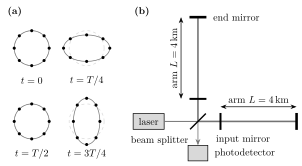
General relativity describes gravity as the curvature of spacetime (Unit 10). When masses accelerate, the curvature around them changes, and the change travels outward at the speed of light as a gravitational wave. A passing wave changes distances. Perpendicular to its direction of travel it stretches space along one axis and squeezes it along the other, and half a period later the two axes have swapped roles (Figure 1a). The size of the effect is the strain.
A source must change shape to radiate, and a binary is the ideal emitter. Its mass distribution repeats after half an orbit, so the wave frequency is twice the orbital frequency, \(f = 2f_{\mathrm{orb}}\). For a binary seen face-on at distance \(r\) the strain is \(h = 8GE_{\mathrm{k}}/(c^{4}r)\), where \(E_{\mathrm{k}}\) is the kinetic energy of the orbital motion. The factor \(G/c^{4} = 8.3\times10^{-45}\unit{s^{2}\,kg^{-1}\,m^{-1}}\) is the reason nobody will ever build a transmitter: to reach \(h = 10^{-21}\) at \(400\unit{Mpc}\) the kinetic energy has to be about \(1\,\Msun c^{2}\).
A detector measures \(h\) itself, which falls as \(1/r\), while a telescope measures a flux that falls as \(1/r^{2}\) (Unit 3). An interferometer that becomes twice as sensitive sees twice as far and surveys eight times the volume.
1.2 Laser interferometers
A gravitational wave detector, the one kind of observatory that Unit 4 left out, is a Michelson interferometer (Figure 1b). A laser beam is split in two, each half travels down a \(4\unit{km}\) vacuum tube to a \(40\unit{kg}\) mirror that hangs as a pendulum, and the returning beams are recombined so that they cancel at the photodetector. A passing wave lengthens one arm and shortens the other, the cancellation is no longer complete, and light reaches the detector. For \(h = 10^{-21}\) an arm changes by \(\Delta L = hL = 4\times10^{-18}\unit{m}\). A second mirror at the start of each arm keeps the light inside for about 300 round trips, which multiplies the effect.
Below \(10\unit{Hz}\) ground motion drowns every signal, and above a few hundred hertz the limit is the counting noise of the photons. Four detectors exist: LIGO Hanford and LIGO Livingston in the USA, Virgo near Pisa and KAGRA in Japan, the last two with arms of \(3\unit{km}\). A single interferometer hears almost the whole sky at once and cannot be pointed, which makes it more of a microphone than a telescope. The direction comes from the network: the wave reaches each site at a slightly different time, and the delays fix a strip of sky.
That gravitational waves exist was known before 2015. The orbit of the binary pulsar PSR B1913+16, found by Russell Hulse and Joseph Taylor in 1974, shrinks at the rate that general relativity predicts for the loss of energy to gravitational radiation, to within 0.2%.