

Dark Matter, Dark Energy and Cosmic Structure
Ordinary matter makes up only 5 percent of the universe. This unit goes through the evidence for dark matter and the searches for it, shows how gravity built the cosmic web of galaxies, and explains why the expansion is accelerating. It ends at the present state of research: the DESI results on dark energy and the unresolved disagreement about the Hubble constant.
1 The evidence for dark matter
About five sixths of the matter in the universe has never shown up in a telescope. It neither emits nor absorbs light, and we know it only by its gravity. Units 8 and 12 presented the first line of evidence, the flat rotation curves of spiral galaxies, which require a halo with ten to twenty times the mass of the stars. The independent lines of evidence collected here rest on different physics and different length scales, and they agree on the amount.
1.1 Galaxy clusters
A rich cluster such as Coma holds about a thousand galaxies within a few megaparsecs, and they move at around \(1000\unit{km\,s^{-1}}\) relative to each other. Unit 12 weighs clusters with the virial theorem and with gravitational lensing, which produces the arcs of Abell 370 in the banner picture. A third method uses the plasma between the galaxies. It has a temperature of \(10^{7}\) to \(10^{8}\unit{K}\), shines in X-rays, and sits in hydrostatic equilibrium, the same balance between pressure gradient and gravity that holds up a star (Unit 9): \(\dd P/\dd r = -GM(<r)\rho/r^{2}\). With the ideal gas law \(P = \rho kT/(\mu m_p)\) this gives the mass \(M(<r)\) inside radius \(r\).
1.2 The Bullet Cluster
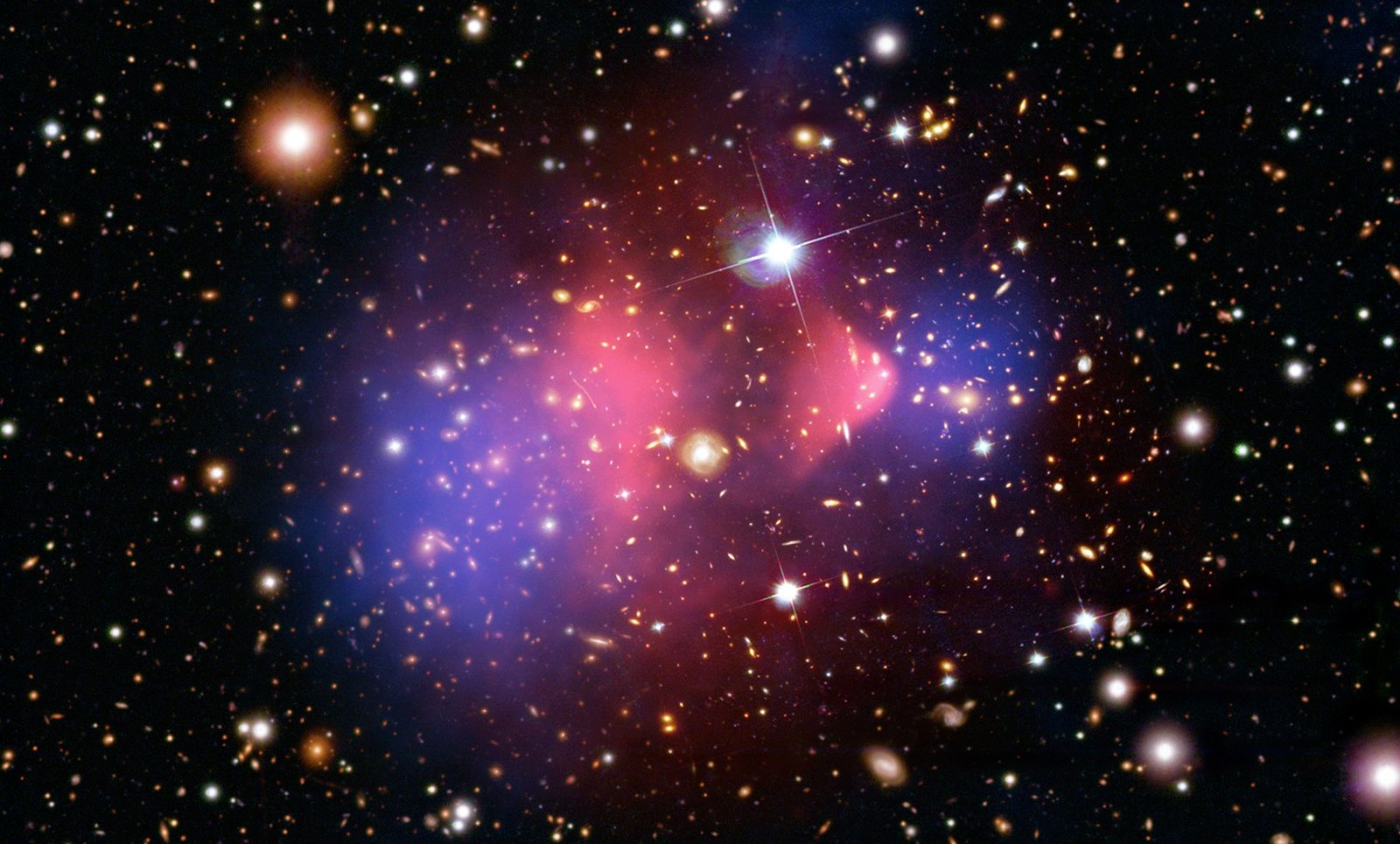
The cluster 1E 0657-56 at redshift \(z = 0.296\) is two clusters seen about 150 million years after a head-on collision (Figure 1). The galaxies of the two clusters passed through each other almost untouched, because the gaps between galaxies are huge compared with their sizes. The gas clouds rammed into each other at several thousand kilometers per second and were slowed by their own pressure. They now lag behind in the middle, where the Chandra X-ray telescope sees a shock front shaped like a bullet. The gas outweighs the stars several times over, so most of the visible matter sits in the middle.
The mass sits elsewhere. A map of the total mass, made by Douglas Clowe and colleagues in 2006 from the weak lensing of background galaxies, has its two peaks on the two groups of galaxies, away from the gas, with an offset significant at \(8\sigma\). Most of the mass went through the collision without friction, as the galaxies did. A change to the law of gravity alone cannot produce this picture, because modified gravity would still pull hardest where the ordinary matter is. A 2025 mass map from JWST images confirmed in finer detail that the mass follows the galaxies. The collision also limits how strongly dark matter particles scatter off each other: the cross section per unit mass must be below roughly \(1\unit{cm^{2}\,g^{-1}}\).
1.3 The baryon budget
Dark matter cannot be ordinary matter that happens to be dim, such as cold gas, planets or dead stars. Two measurements from the early universe count all ordinary matter (baryons, in the jargon of cosmology) whether it shines or not, and both find too little. The deuterium left over from primordial nucleosynthesis fixes the baryon density at about 5% of the critical density (Unit 14). The acoustic peaks of the cosmic microwave background (CMB) separate the two kinds of matter, because the photons pushed the baryons around before decoupling and left the dark matter alone: the relative heights of the first three peaks give both densities. In units of the critical density of Unit 13, the Planck satellite found \[ \Omega_b = 0.049, \qquad \Omega_c = 0.265, \qquad \Omega_m = \Omega_b + \Omega_c \approx 0.315 \] for the baryons, the cold dark matter and their sum. The dark matter outweighs the baryons by 5.4 to 1.