

The Astronomer's Toolkit
This unit collects the mathematics and physics that the rest of the program uses: powers of ten, astronomical units, angles on the sky, logarithms, scaling laws, Newtonian mechanics and the handling of uncertainty. Every tool is practiced on a real case, such as counting the galaxies in the universe from one Hubble image or weighing the density of a planet around another star.
1 Powers of ten and the scales of the universe
Written out in full, the mass of the Sun and the mass of a proton look like this: \begin{align*} \Msun &= 1\,988\,000\,000\,000\,000\,000\,000\,000\,000\,000\unit{kg},\\ m_{\mathrm{p}} &= 0.000\,000\,000\,000\,000\,000\,000\,000\,001\,67\unit{kg}. \end{align*} Nobody can read such numbers. Astronomy handles quantities that differ by sixty factors of ten, so its first tool is a compact way to write them.
In scientific notation a number is a factor between 1 and 10 times a power of ten: \(\Msun = 1.99\times10^{30}\unit{kg}\) and \(m_{\mathrm{p}} = 1.67\times10^{-27}\unit{kg}\). Arithmetic follows the rules for powers: \[ 10^{a}\times10^{b} = 10^{a+b}, \qquad \frac{10^{a}}{10^{b}} = 10^{a-b}, \qquad \left(10^{a}\right)^{b} = 10^{ab}, \qquad 10^{-a} = \frac{1}{10^{a}} . \] A fractional exponent is a root, so \(10^{1/2} = \sqrt{10} \approx 3.16\) and \(x^{3/2} = x\sqrt{x}\). To multiply or divide two numbers, treat the leading factors and the exponents separately. The number of protons that add up to the mass of the Sun is \[ N = \frac{\Msun}{m_{\mathrm{p}}} = \frac{1.99\times10^{30}}{1.67\times10^{-27}} = \frac{1.99}{1.67}\times10^{30-(-27)} = 1.19\times10^{57}. \] The Sun consists mostly of hydrogen, whose nucleus is a single proton, so it contains about \(10^{57}\) atomic nuclei. On a calculator, enter powers of ten with the EE or EXP key.
1.1 A tour of the scales
Figure 1 places a few objects on a logarithmic axis, where each tick is a factor of ten in length. The proton, \(1.7\times10^{-15}\unit{m}\) across, sits at the left end. An atom is \(10^{5}\) times wider than its nucleus. In a neutron star gravity has crushed the atoms, and more than one solar mass fits into a ball 24 km across (Unit 10). The Earth has a diameter of \(1.27\times10^{7}\unit{m}\) and the Sun one of \(1.39\times10^{9}\unit{m}\), 109 Earths in a row. Light takes 499 s to cross the \(1.50\times10^{11}\unit{m}\) between the Sun and the Earth and four hours to reach Neptune.
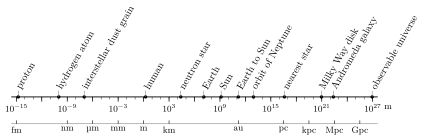
Beyond Neptune the axis stays nearly empty for more than three powers of ten. The nearest star, Proxima Centauri, is 268,000 Earth distances away, at \(4.02\times10^{16}\unit{m}\). If the Sun were a marble 1 cm across, the Earth would be a speck of dust 1 m from it, and the next marble would lie 290 km away. Stars therefore almost never collide, even when two galaxies merge (Unit 12). The disk of the Milky Way measures about \(10^{21}\unit{m}\) and contains a few hundred billion stars. The Andromeda galaxy lies at \(2.4\times10^{22}\unit{m}\), and the part of the universe from which light has had time to reach us is about \(8.8\times10^{26}\unit{m}\) across (Unit 13). The proton and this horizon are 42 powers of ten apart. Masses span even more: the Milky Way with its dark matter has about \(10^{12}\,\Msun = 2\times10^{42}\unit{kg}\), or \(10^{69}\) proton masses.
1.2 Orders of magnitude and estimation
One factor of ten is called an order of magnitude. Three symbols relate two quantities: \(A \approx B\) means approximately equal, \(A \sim B\) means equal to within a factor of a few, and \(A \propto B\) means proportional, so that doubling \(B\) doubles \(A\).
In astronomy the nearest power of ten is often real knowledge, and getting it takes seconds. Round every input to one significant digit, multiply the leading factors in your head and add the exponents. A year has \(365\times24\times3600 \approx (4\times10^{2})(2\times10^{1})(4\times10^{3}) \sim 3\times10^{7}\) seconds. The exact value is \(3.156\times10^{7}\unit{s}\), which physicists remember as \(\pi\times10^{7}\unit{s}\).
The same method counts the stars of the Milky Way. They have a combined mass of about \(5\times10^{10}\,\Msun\), and a typical star is a red dwarf of a few tenths of a solar mass, so there are \(\sim10^{11}\) of them. Published counts lie between 100 and 400 billion. A quick estimate also protects against calculator mistakes: if a careful computation disagrees with it by a factor of \(10^{6}\), one of the two contains an error, and it is usually the careful one.