The Sky and Celestial Mechanics
This unit starts with what anyone can see: the daily turning of the sky, the seasons, the phases of the Moon and eclipses. It then goes through Kepler's laws to Newton's gravitation and shows how a single force law lets us weigh the Sun and work out the speed a spacecraft needs to leave the solar system.
1 The celestial sphere
The stars lie at very different distances, and the eye cannot tell. On a dark night they all seem fixed to the inside of one huge dome. Astronomers keep this picture as a tool: the celestial sphere is an imaginary sphere around the observer, and a position on it is a direction, given by two angles.
The simplest pair of angles uses your own surroundings. The zenith is the point straight overhead and the horizon is the great circle \(90^\circ\) from it. The altitude \(h\) of a star is its angle above the horizon, and its azimuth is the compass bearing of the point on the horizon below it. The great circle from the north point of the horizon through the zenith to the south point is the meridian. Altitude and azimuth are easy to measure and useless in a catalog, because they change by the minute as the Earth turns.
A catalog needs coordinates that stay with the stars. The Earth’s rotation axis, extended, meets the sphere at the two celestial poles, and the plane of the Earth’s equator cuts it in the celestial equator. The declination \(\delta\) of a star is its angle north (positive) or south (negative) of the celestial equator, the counterpart of geographic latitude. The counterpart of longitude is the right ascension \(\alpha\). It is counted eastward along the equator from the vernal equinox, the point where the Sun crosses the equator in March, and it is given in hours, with \(24\unit{h}\) for the full circle. Sirius has \(\alpha = 6\unit{h}\;45\unit{min}\) and \(\delta = -16.7^\circ\) for every observer on Earth.
Figure 1 shows how the two systems fit together at northern latitude \(\varphi\). The north celestial pole stands above the north point of the horizon at an altitude equal to \(\varphi\). Polaris lies \(0.6^\circ\) from the pole, so its altitude tells you your latitude.
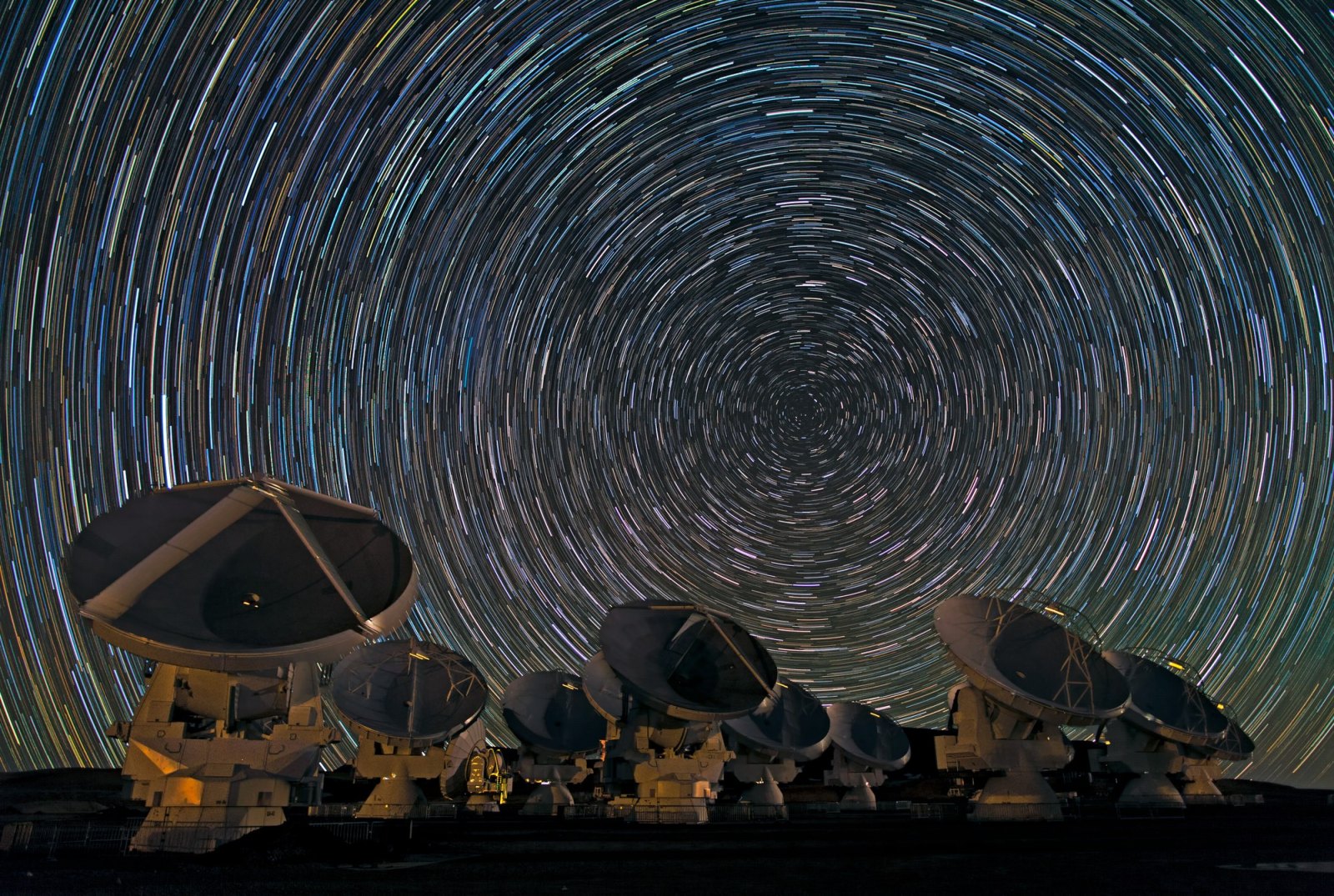
The Earth rotates from west to east, so the sky appears to turn the other way around the celestial poles (Figure 2). Each star moves on a circle of constant declination: it rises in the east, climbs until it crosses the meridian, and sets in the west. The meridian crossing is called culmination, and the star then stands highest. In Figure 1 the celestial equator crosses the meridian at altitude \(90^\circ - \varphi\) above the south point, and a star of declination \(\delta\) culminates higher by \(\delta\).
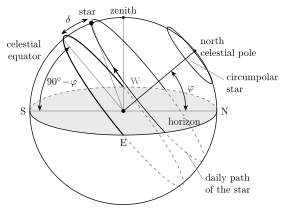
Two limits follow. A star with \(\delta > 90^\circ - \varphi\) never sets, because even at its lowest point below the pole it stays above the horizon; such stars are circumpolar. A star with \(\delta < -(90^\circ - \varphi)\) never rises. Acrux in the Southern Cross, at \(\delta = -63.1^\circ\), is invisible from every place north of latitude \(26.9^\circ\).