 Image: NASA, ESA, Hubble Heritage Team
The life cycle of a star and what it leaves behind
The Sun is 4.57 billion years old and has used up roughly half of the hydrogen in its core. In another five billion years it will swell into a red giant, shed its outer layers and end as a white dwarf the size of the Earth. A star with twenty times the Sun's mass lives a thousand times shorter and finishes with an explosion. Mass at birth decides nearly everything about a star, above all how long it lasts and what it leaves behind.
Birth in cold clouds
Stars form in molecular clouds, the coldest places in a galaxy. The gas there is mostly molecular hydrogen at 10 to 20 K, and a single cloud can hold up to a million solar masses. Gas pressure normally holds a clump up against its own weight. When a clump is massive and cold enough, gravity wins and it starts to contract. The threshold is called the Jeans mass.
The collapsing clump heats up as it shrinks, because gravitational energy is converted into heat. For a star like the Sun this protostar phase lasts a few tens of millions of years. It ends when the center reaches about 10 million kelvin and hydrogen nuclei begin to fuse into helium. Objects below about 0.075 solar masses, some 80 times the mass of Jupiter, never get that hot. They are called brown dwarfs, and they slowly cool and fade.
The main sequence
A star spends about 90 percent of its life fusing hydrogen in its core. In this phase it is stable: the pressure of the hot gas balances gravity, and the energy that leaks out of the surface is replaced by fusion. The Sun's core is at 15.7 million kelvin, and every second the Sun turns 4.3 million tonnes of mass into energy.
More massive stars have hotter cores and burn their fuel far faster than their extra mass can make up for. A useful rule is that the hydrogen-burning lifetime scales as \(M^{-2.5}\), with 10 billion years for one solar mass. For the heaviest stars the rule gives too short a life, so the last two rows of the table use values from stellar models.
| Mass at birth (Sun = 1) | Time on the main sequence | Remnant |
|---|---|---|
| 0.1 | Trillions of years | White dwarf |
| 1 | 10 billion years | White dwarf |
| 10 | 20 to 30 million years | Neutron star |
| 25 | About 7 million years | Neutron star or black hole |
The first row has a curious consequence. The universe is 13.8 billion years old, so no red dwarf has ever finished its life. Every one that was ever born is still shining.
How stars like the Sun end
When the core hydrogen is gone, the core contracts and heats, and hydrogen keeps burning in a shell around it. The outer layers respond by swelling. The Sun will grow to more than a hundred times its present radius and its surface will cool to an orange-red glow: a red giant.
At about 100 million kelvin the helium in the core ignites. Three helium nuclei fuse into one carbon nucleus, and some of the carbon captures a fourth to become oxygen. Nearly all the carbon in your body was made this way inside stars that died before the Sun was born.
A star of this kind never gets hot enough to burn carbon. In its last giant phase it becomes unstable and blows its envelope into space over some tens of thousands of years. The exposed core lights the expelled gas up as a planetary nebula for 10,000 to 20,000 years. What remains is a white dwarf, typically 0.6 solar masses packed into the volume of the Earth. A teaspoon of its material would weigh about five tonnes. A white dwarf has no energy source. It is held up by the pressure of electrons squeezed as tightly as quantum mechanics allows, and it simply cools.
That pressure has a limit: a white dwarf above 1.4 solar masses, the Chandrasekhar limit, cannot support itself. One that is pushed toward the limit by a companion star explodes as a Type Ia supernova, the kind that astronomers use to measure distances.
How massive stars end
Stars born with more than about 8 solar masses go further. Their cores become hot enough to fuse carbon, then neon, oxygen and silicon, each fuel in a shell around the next like the layers of an onion. Each stage yields less energy and is over sooner. For a star of 25 solar masses, hydrogen lasts about 7 million years and helium several hundred thousand. Carbon is gone in a few centuries, oxygen in months, and silicon burns to iron in about a day.
Iron is the end of the line, because fusing iron consumes energy. Once the iron core passes about 1.4 solar masses, electron pressure gives way and the core collapses in less than a second into a ball about 12 km in radius: a neutron star, with a density near \(4 \times 10^{17}\) kg per cubic meter. The collapse releases around \(10^{46}\) joules, about a hundred times what the Sun will radiate in its whole life. Roughly 99 percent of it leaves as neutrinos, and the rest blows the star apart as a core-collapse supernova.
We have seen this happen nearby once in modern times. Supernova 1987A appeared in the Large Magellanic Cloud, about 160,000 light years away, on 23 February 1987. Detectors on Earth caught about two dozen of its neutrinos a few hours before the light arrived. In 2024 the James Webb Space Telescope found the best evidence yet for the neutron star at the center of the debris.
If the collapsing core is too heavy for a neutron star, with a limit somewhere above 2 solar masses, nothing can stop it and a black hole forms. Which stars take this route is less certain than textbooks suggest. It depends on how much mass the star lost in winds and on whether a companion stripped or fed it, and most massive stars do have a close companion.
What the remnants give back
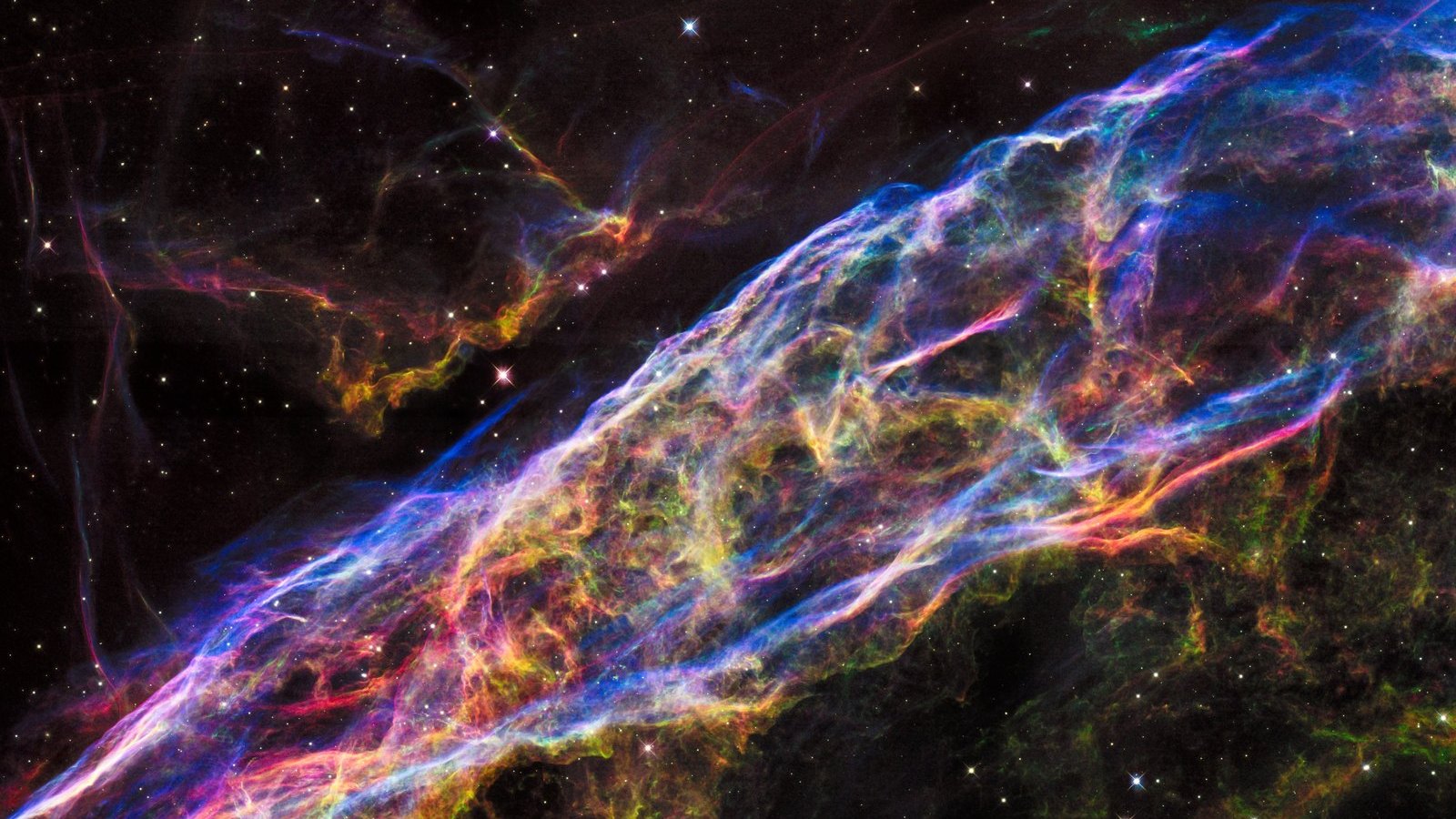
The cover picture shows part of the Veil Nebula, the wreck of a star about 20 times the mass of the Sun that exploded roughly 10,000 years ago. The glowing filaments are gas that the blast wave has swept up and heated. Material like this mixes into the interstellar clouds and ends up in the next generation of stars.
The chemical bookkeeping is known in outline. Much of the carbon and nitrogen comes from the winds of dying low mass stars, and most of the oxygen from massive stars that exploded. Type Ia supernovae supply the larger part of the iron. The heaviest elements, gold among them, are forged at least in part when neutron stars collide, as the merger observed in August 2017 showed. About 1.4 percent of the Sun's mass consists of elements heavier than helium, all of it inherited from stars that lived before. NASA's overview of stars has more pictures of each stage.
In the A&A Masterclass this story is the subject of Unit 7, The Lives and Deaths of Stars. Unit 9 explains the fusion reactions and the equations of stellar structure behind it, and Unit 10 treats white dwarfs, neutron stars and black holes in detail. All units are listed in the curriculum.