

Stellar Structure and Nuclear Fusion
Four equations describe the inside of a star, and with a pocket calculator they give the pressure and temperature at the center of the Sun. You learn why protons fuse at a temperature a thousand times too low for classical physics, how the pp chain, the CNO cycle and the triple alpha process work, and how neutrino detectors deep underground checked all of it. The unit ends with the mass limits of stars and the origin of the elements beyond iron.
1 A star in balance
Switch off the pressure inside the Sun and it would fall in on itself in about half an hour. The Sun has instead kept its radius to within about 15% for 4.6 billion years. At every depth, then, the inward pull of gravity is matched by pressure, and the match is very precise. Unit 6 described the layers of the Sun as observers find them. Here we write down the equations that make the layers what they are, and then ask how the center stays hot.
1.1 Hydrostatic equilibrium and the equation of state
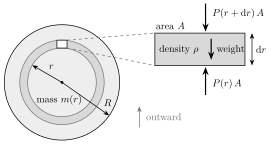
Take a thin shell of gas at distance \(r\) from the center, with thickness \(\dd r\), and cut a small block with face area \(A\) out of it (Figure 1). The gas below pushes the block outward with the force \(P(r)A\), where \(P\) is the pressure. The gas above pushes it inward with \(P(r+\dd r)A\). Gravity pulls its mass \(\rho A\,\dd r\), with \(\rho\) the density, toward the center. By Newton’s shell theorem (Unit 2) only the mass \(m(r)\) inside radius \(r\) pulls on the block, as if all of it sat at the center, so the gravitational acceleration is \(Gm(r)/r^{2}\).
The link between pressure, density and temperature is the equation of state. Stellar gas is ionized and its particles are tiny compared with the distances between them, so the ideal gas law works well: \begin{equation} P = \frac{\rho\,kT}{\mu\,m_{\mathrm{H}}} + \frac{4\sigma}{3c}\,T^{4} . \label{eq:eos} \end{equation} Here \(k\) is the Boltzmann constant, \(m_{\mathrm{H}} = 1.67\times10^{-27}\unit{kg}\) the mass of a hydrogen atom, and \(\mu\) the mean molecular weight, the average mass per free particle in units of \(m_{\mathrm{H}}\). Ionized hydrogen supplies two particles, a proton and an electron, for each \(m_{\mathrm{H}}\), so pure hydrogen has \(\mu = 1/2\). Ionized helium supplies three particles for \(4\,m_{\mathrm{H}}\), and in general \(1/\mu = 2X + \tfrac{3}{4}Y + \tfrac{1}{2}Z\) for the mass fractions \(X\), \(Y\) and \(Z\) of hydrogen, helium and heavier elements. The mixture at the solar surface, 71% hydrogen and 27% helium by mass, has \(\mu = 0.61\). The second term is the pressure of the photons, with the Stefan-Boltzmann constant \(\sigma\) from Unit 3. At the center of the Sun it adds 0.07% to the pressure. In a star of \(50\,\Msun\) it supplies more than a quarter, and Section 6 shows where that leads.
1.2 Energy transport
The center of the Sun is at 15.7 million kelvin and the surface at 5772 K, so heat flows outward, as radiation or by convection. A photon in the solar interior flies only a short distance before an electron or an ion scatters or absorbs it. This mean free path is \(\ell = 1/(\kappa\rho)\), where the opacity \(\kappa\) is the cross-section that one kilogram of gas presents to the radiation. In the Sun \(\ell\) is 0.05 mm at the center and a few millimeters farther out. Every flight starts in a random direction, and a random walk of \(N\) steps covers a distance of only \(\sqrt{N}\,\ell\). A path out of the Sun therefore needs \(N = (R/\ell)^{2}\) steps and takes the time \(N\ell/c = R^{2}/(\ell c)\). With \(\ell = 1\unit{mm}\) this is \(1.6\times10^{12}\unit{s}\), or 50 000 years, and detailed calculations land between \(10^{4}\) and \(2\times10^{5}\) years.
Photons diffuse outward only if there are more of them inside than outside, which requires a temperature that falls with radius: \begin{equation} \frac{\dd T}{\dd r} = -\frac{3\,\kappa\,\rho\,L(r)}{64\pi\sigma\,r^{2}\,T^{3}} . \label{eq:radgrad} \end{equation} \(L(r)\) is the power that crosses the sphere of radius \(r\). A high opacity or a large flux needs a steep drop in temperature to push the energy through.
If the required gradient gets too steep, the gas starts to boil. Picture a blob of gas that is nudged upward. It expands until its pressure matches the lower pressure around it, and it cools in the process without exchanging heat, which is called adiabatic cooling. If the surroundings cool faster with height than the blob does, the blob arrives hotter and lighter than its new neighbors and keeps rising. Convection therefore sets in where the gradient of Equation \eqref{eq:radgrad} is steeper than the adiabatic gradient inside such a blob, a condition that Karl Schwarzschild wrote down in 1906. This happens where the opacity is large, as in cool outer layers in which hydrogen is only partly ionized. The outer 29% of the solar radius convects for this reason. It also happens where \(L(r)/r^{2}\) is large, as in the cores of stars above about \(1.3\,\Msun\), whose fusion is packed into a very small central volume. Stars below \(0.35\,\Msun\) convect all the way through.
The last equation counts the energy. Each shell adds its own output to the luminosity, \(\dd L/\dd r = 4\pi r^{2}\rho\,\varepsilon\), where \(\varepsilon\) is the power released per kilogram by nuclear reactions.
We now have four differential equations for \(P\), \(m\), \(T\) and \(L\), plus three properties of the gas that depend on density, temperature and composition: the equation of state, \(\kappa\) and \(\varepsilon\). Fix the mass and the composition of a star and the solution is, with rare exceptions, unique. This Vogt-Russell theorem explains why the main sequence of Unit 6 is a sequence in mass.