 Image: NASA/ESA, The Hubble Heritage Team and A. Riess (STScI)
How astronomers measure the distance to the stars
The nearest star to the Sun, Proxima Centauri, is 4.25 light years away. Nobody has sent a radar pulse there and waited for the echo. The number comes from geometry, and every larger distance in astronomy, out to galaxies billions of light years away, rests on a chain of methods that begins with that same geometry.
Parallax, the method that needs no physics
Hold a finger at arm's length and look at it with one eye, then the other. The finger jumps against the background. Astronomers do the same with the Earth's orbit as the baseline. Six months apart, the Earth sits on opposite sides of the Sun, 300 million km from where it was, and a nearby star appears slightly shifted against far more distant ones. Half of that total shift is called the parallax angle \(p\), and the distance follows from
\[ d = \frac{1}{p} \]with \(d\) in parsecs and \(p\) in arcseconds. One parsec is 3.26 light years. An arcsecond is 1/3600 of a degree, about the size of a 2 cm coin seen from 4 km. Proxima Centauri has a parallax of 0.768 arcseconds, so its distance is 1/0.768 = 1.30 parsecs. Every other star has a smaller parallax than that, which is why nobody managed the measurement before 1838. In that year Friedrich Bessel published 0.314 arcseconds for the star 61 Cygni. The modern value is 0.286 arcseconds, or 11.4 light years, so he was within 10 percent.
From the ground, the blurring of the atmosphere limits parallaxes to stars within roughly 100 parsecs. The Hipparcos satellite (1989 to 1993) measured about 118,000 stars to a thousandth of an arcsecond. Its successor Gaia observed from 2014 until January 2025, and its third data release in 2022 contains parallaxes for nearly 1.5 billion stars. For bright stars the uncertainty is around 0.02 milliarcseconds. At that level a star 5,000 parsecs away, with a parallax of 0.2 milliarcseconds, still has its distance known to 10 percent. The fourth release, based on five and a half years of data, is scheduled for 2 December 2026.
Even Gaia runs out of reach inside our own galaxy. The center of the Milky Way is about 8,200 parsecs away, and the nearest large galaxy is almost a hundred times farther. Beyond a few thousand parsecs we need a different idea.
Standard candles and the inverse square law
Light spreads over a sphere, so the flux \(F\) we receive from a source of luminosity \(L\) at distance \(d\) is \(F = L/(4\pi d^2)\). Move a lamp twice as far away and it looks four times fainter. If you know how much light an object truly emits, you measure how bright it appears and solve for \(d\). An object whose luminosity is known in advance is called a standard candle.
Astronomers usually write this with magnitudes. The apparent magnitude \(m\) and the absolute magnitude \(M\) (the magnitude the object would have at 10 parsecs) are related by \(m - M = 5\log_{10}(d/10\,\mathrm{pc})\). The whole difficulty lies in finding objects whose \(M\) you can trust. The ten equations article works through both formulas with numbers.
Cepheids, the stars that tell you their luminosity
Cepheid variables are giant stars that swell and shrink with a regular period of days to months. In 1912 Henrietta Leavitt published the periods of 25 Cepheids in the Small Magellanic Cloud and showed that the brighter ones pulsate more slowly. Since all of them sit at nearly the same distance from us, the relation had to be one between period and true luminosity. Time the pulsation and you know \(M\). A Cepheid with a ten day period emits several thousand times the luminosity of the Sun, which is why these stars can be picked out in other galaxies.
The relation still needs a zero point, and that comes from Cepheids in the Milky Way that are close enough for Gaia parallaxes. This is the first place where one method hands over to the next.
Suppose a Cepheid in a distant galaxy has a period that implies \(M = -6\), and it appears at \(m = 26\). Then \(m - M = 32\), so \(d = 10^{32/5 + 1}\) parsecs, which is 25 million parsecs or about 82 million light years. Edwin Hubble found a Cepheid in the Andromeda nebula in 1923, and the distance he derived settled a long argument: Andromeda lies far outside the Milky Way. The current value is about 2.5 million light years. With the Hubble Space Telescope, individual Cepheids have been measured in galaxies out to roughly 40 million parsecs.
Type Ia supernovae reach across the universe
At larger distances single stars fade into the glow of their galaxy, and something brighter is needed. A Type Ia supernova is the thermonuclear explosion of a white dwarf. At peak it reaches an absolute magnitude near \(M = -19.3\), about five billion times the luminosity of the Sun, and for a few weeks it can rival its host galaxy. The peak luminosity varies a little from one explosion to the next. Brighter ones fade more slowly, and after a correction for this the scatter in distance is only a few percent.
Type Ia supernovae are visible at redshifts above 1, which means their light has traveled for more than half the age of the universe. In 1998 two teams used them to show that the cosmic expansion is speeding up.
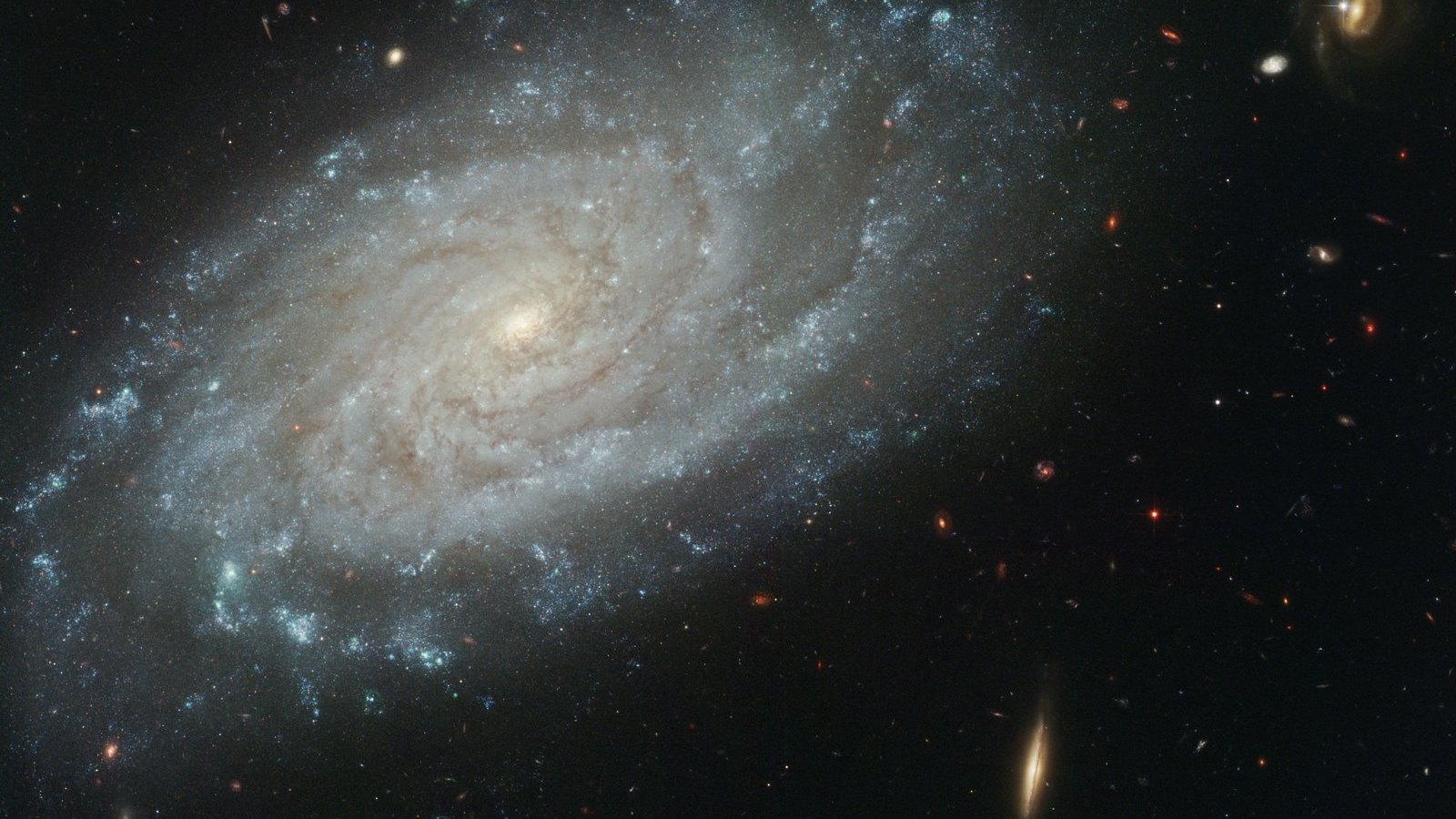
Their luminosity has to be calibrated too. That requires galaxies close enough to show Cepheids and lucky enough to have hosted a Type Ia supernova. The spiral galaxy NGC 3370 in the picture above is one of them: a supernova was seen there in 1994, and Hubble later found Cepheids in its arms at a distance of about 98 million light years.
Why astronomers call it a ladder
| Method | Useful range | Calibrated by |
|---|---|---|
| Radar and spacecraft ranging | Solar system | Speed of light |
| Parallax | A few thousand parsecs | Size of the Earth's orbit |
| Cepheids and red giant stars | About 40 million parsecs | Parallax |
| Type Ia supernovae | Billions of parsecs | Cepheids and red giants |
| Redshift and the Hubble-Lemaître law | Observable universe | Supernovae |
Each rung is calibrated by the one below it, so an error near the bottom travels all the way up. To guard against that, astronomers look for geometric distances that skip rungs. Pairs of eclipsing stars in the Large Magellanic Cloud give its distance as 49.6 kiloparsecs with an uncertainty of 1 percent. Water masers orbiting the central black hole of the galaxy NGC 4258 give 7.58 million parsecs from orbital geometry alone. Cepheids in both places can then be checked against the Milky Way calibration.
The top of the ladder delivers the Hubble constant, the present expansion rate of the universe. The ladder gives about 73 km/s per megaparsec, while the value predicted from the cosmic microwave background is about 67. That disagreement is the subject of the Hubble tension, and it is why so much effort goes into every rung.
In the A&A Masterclass the ladder is built over several units. Unit 2 introduces parallax and the parsec, Unit 3 covers flux, magnitudes and the distance modulus, Unit 6 shows what Gaia did for stellar distances, and Unit 8 puts Cepheids and supernovae together. The measurement of the Hubble constant returns in Unit 13. The full list is in the curriculum.