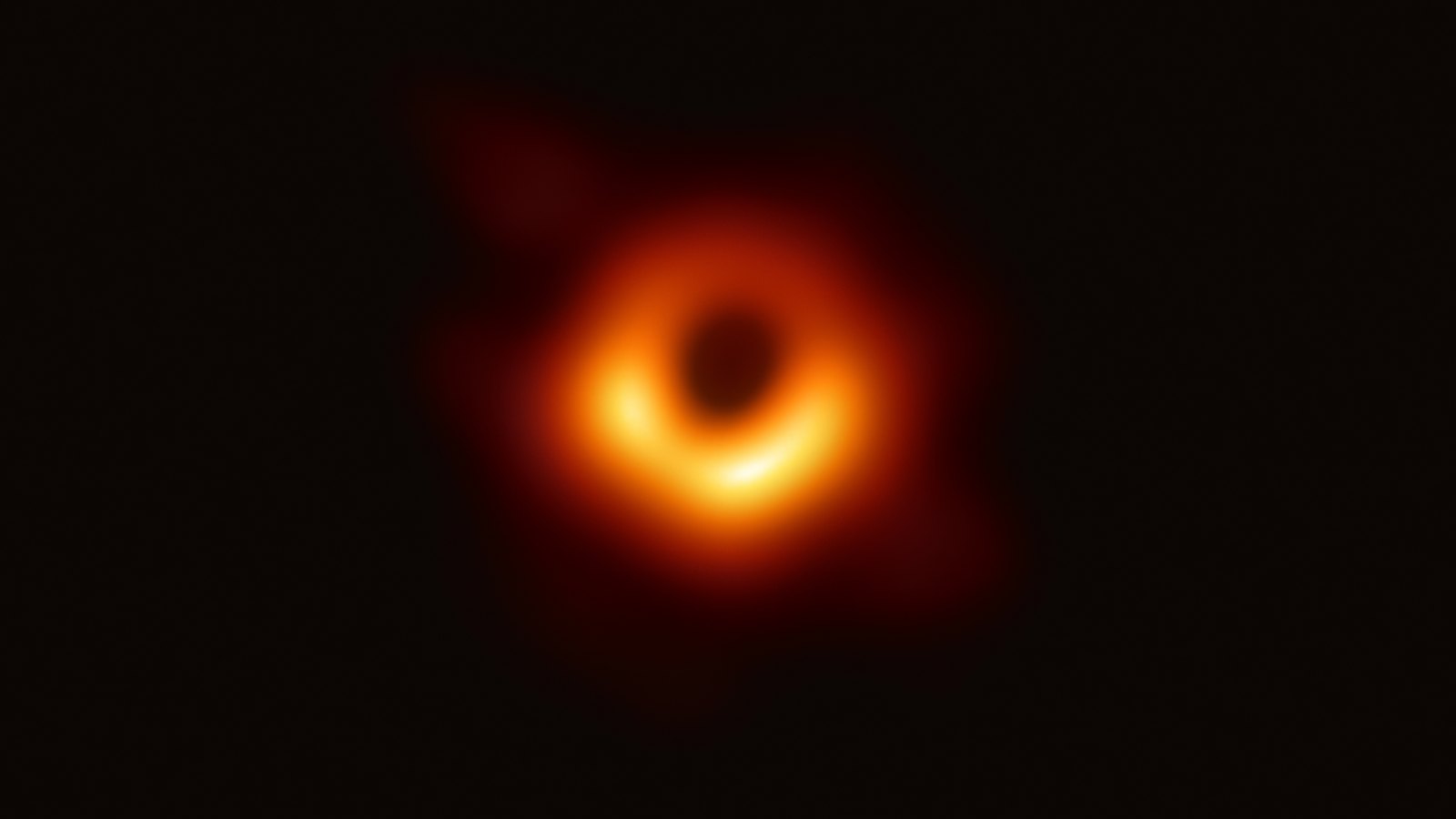
 Image: EHT Collaboration
What a black hole is and what it is not
Squeeze the Sun into a ball 3 km in radius and light could no longer leave it. That radius, called the Schwarzschild radius, is given by
\[ r_s = \frac{2GM}{c^2} \]and it grows in proportion to the mass \(M\): 2.95 km for each solar mass, and just under 9 mm for the Earth. A black hole is a region of space bounded by a surface of this size, the event horizon, from inside which nothing can get out. Most of what people believe about black holes beyond this definition comes from films, and a good part of it is wrong.
What astronomers mean by a black hole
A black hole has very few properties. Its mass and its spin describe it completely (an electric charge is possible in theory but would be neutralized quickly). Two kinds are well established. Stellar black holes, with a few to about a hundred solar masses, form when the core of a massive star collapses at the end of its life. Supermassive black holes sit in the centers of galaxies and have millions to billions of solar masses.
The one in the center of the Milky Way, Sagittarius A*, has 4.3 million solar masses and is about 27,000 light years away. Its event horizon has a radius of 12.7 million km, about 18 times the radius of the Sun. It would fit comfortably inside the orbit of Mercury.
Do black holes suck everything in?
Far from the horizon, the gravity of a black hole is the same as that of any other object of equal mass. Suppose the Sun were replaced by a black hole of one solar mass (it cannot become one, since it is far too light). The Earth would freeze in the dark, but it would continue on the same orbit with the same year, and nothing would pull it inward.
Falling into a black hole is hard for the same reason that falling into the Sun is hard: anything in orbit has angular momentum and keeps missing the center. Gas gets in only by rubbing against other gas in a disk and slowly losing that momentum. Stars orbit Sagittarius A* just as planets orbit the Sun. One of them, S2, circles it every 16 years, and in 2018 it passed within about 120 times the Earth-Sun distance at 7,700 km/s without harm. Tracking such orbits earned Reinhard Genzel and Andrea Ghez a share of the 2020 Nobel Prize in Physics.
Sagittarius A* holds less than a hundredth of a percent of the mass of the galaxy's stars, so there is no prospect of it swallowing the Milky Way.
Is a black hole the densest thing there is?
The horizon is a boundary in empty space and has no material surface. If you divide the mass by the volume inside the horizon anyway, you get an average density that falls with the square of the mass, because the radius grows with \(M\) and the volume with \(M^3\). For one solar mass the figure is \(2 \times 10^{19}\) kg per cubic meter, far beyond an atomic nucleus. For the 6.5 billion solar mass black hole in the galaxy M87 it is 0.4 kg per cubic meter, a third of the density of the air you are breathing.
What happens to the matter inside is unknown. General relativity predicts that it ends in a point of infinite density, a singularity. Most physicists read that as a sign that the theory stops working there, and a quantum theory of gravity that could replace it does not exist yet.
Can a black hole be seen?
The hole itself emits nothing we can detect, yet its surroundings include the brightest objects in the universe. Gas spiraling inward through a disk heats up until it glows in ultraviolet light and X-rays, and it radiates away roughly 10 percent of its rest mass energy before it crosses the horizon. Hydrogen fusion in stars releases 0.7 percent. A quasar, which is a supermassive black hole swallowing a few solar masses per year, can outshine its whole galaxy.
Black holes are found in four ways.
- Radio images. The picture at the top of this article is real. The Event Horizon Telescope, a network of radio dishes spread across the planet, published it on 10 April 2019. It shows hot gas around the black hole of M87, 55 million light years away, with the dark shadow of the hole in the middle. An image of Sagittarius A* followed on 12 May 2022.
- X-rays from gas that a black hole pulls off a companion star. Cygnus X-1, the first strong candidate, was identified this way in the early 1970s.
- Gravitational waves. On 14 September 2015 the LIGO detectors recorded two black holes of about 36 and 29 solar masses merging into one of 62. The missing three solar masses left as gravitational waves within a fraction of a second. The catalogs now hold more than 200 mergers. The heaviest, announced in 2025, produced a black hole of roughly 225 solar masses.
- The wobble of a companion star. The Gaia satellite found a Sun-like star 1,560 light years away that orbits an invisible partner of nearly 10 solar masses. Gaia BH1 is the nearest black hole known. In 2024 Gaia added BH3, with 33 solar masses at 1,926 light years.
Would you be torn apart at the horizon?
The stretching known as spaghettification comes from the difference in gravity between your head and your feet. That difference depends on how fast gravity changes with distance, and at the horizon it gets weaker as the black hole gets bigger. Near a stellar black hole you would be pulled apart long before reaching the horizon. At a black hole like the one in M87 you would cross the horizon without feeling anything unusual, and trouble would come later, deeper inside.
Time behaves strangely too. A distant observer sees a falling clock tick more and more slowly and its light grow redder and fainter. The clock never quite reaches the horizon in that view. The falling clock itself records nothing special and crosses in a finite time. Both descriptions are correct, and they do not contradict each other because the two observers cannot compare notes afterwards.
Do black holes last forever?
In 1974 Stephen Hawking showed that quantum effects make a black hole radiate like a warm body. The temperature is inversely proportional to the mass and comes to \(6 \times 10^{-8}\) K for one solar mass. That is far colder than the 2.7 K microwave background that fills space, so every black hole known today absorbs more energy than it emits and is growing. In a much older and colder universe, a solar mass black hole would evaporate in about \(2 \times 10^{67}\) years. Hawking radiation has never been observed, and for astrophysical black holes it is too weak to measure. NASA's black hole pages cover the types and the observations in more depth.
In the A&A Masterclass, Unit 10 derives the Schwarzschild radius and explains how stellar black holes are found, together with white dwarfs and neutron stars. Unit 12 deals with supermassive black holes, quasars and the Event Horizon Telescope images, and Unit 16 with gravitational waves. See the curriculum.