

The Milky Way, Galaxies and the Expanding Universe
This unit maps the Milky Way and weighs it with the orbits of its stars, which leads to the case for dark matter. It then builds the distance ladder that reaches other galaxies, sorts those galaxies into types, and follows their redshifts to the Hubble-Lemaître law, the cosmic microwave background and an age of 13.8 billion years. It closes the Foundation part of the program with an inventory of what the universe contains.
1 The Milky Way
1.1 A disk seen from inside
On a dark night the Milky Way is a faint band of light around the whole sky, and the geometry follows from that alone: we live inside a flat system of stars. Figure 1 is the modern version of the view, built from nearly 1.7 billion stars measured by the Gaia satellite (Unit 4). The band swells toward the constellation Sagittarius, where the central bulge lies, and dark filaments of interstellar dust hide the stars behind them.
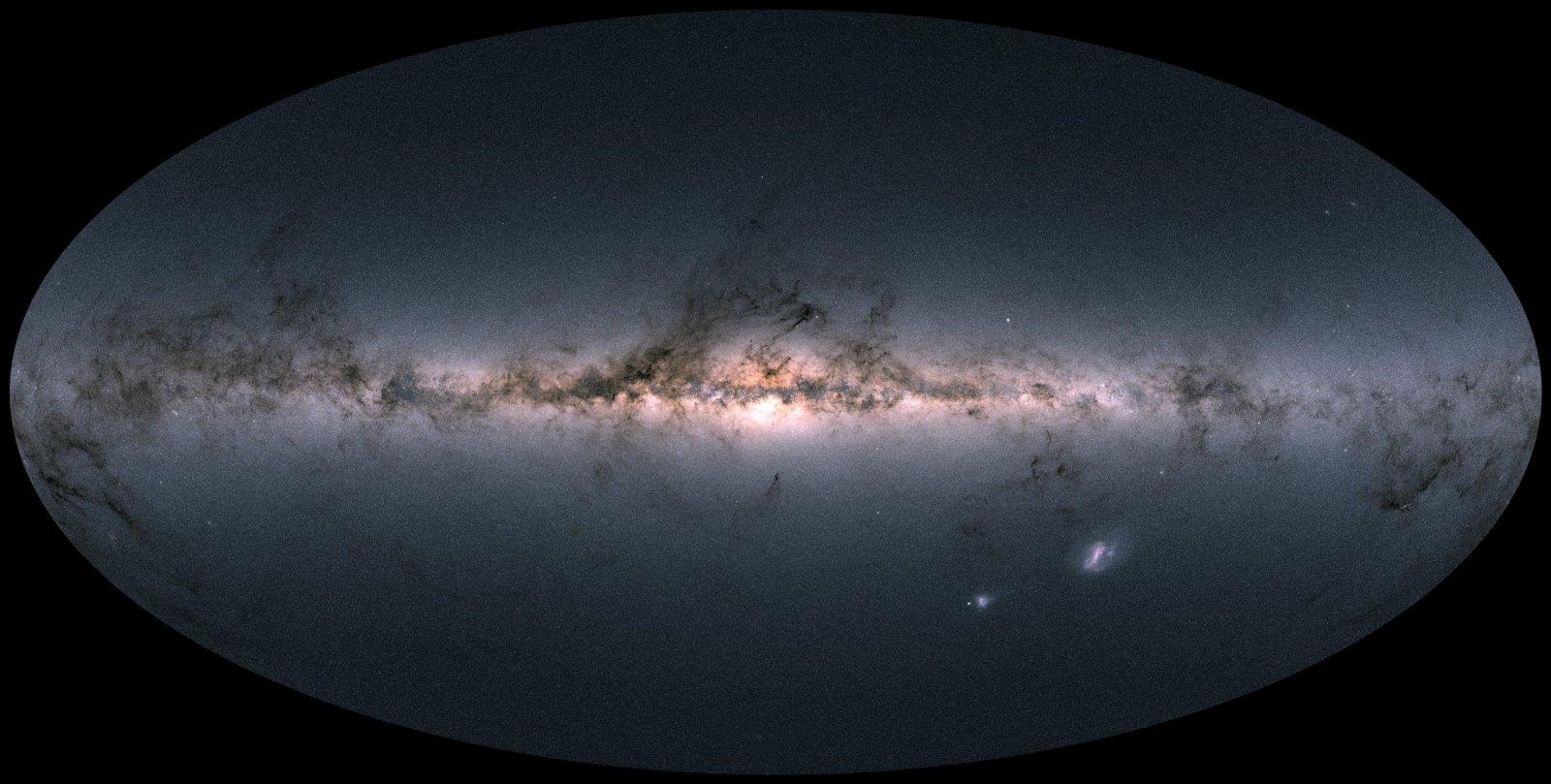
The dust misled astronomers for more than a century. William Herschel counted stars in 683 directions in the 1780s and concluded that the Sun sits near the center. Because of the dust (the extinction of Unit 3) he saw only the nearest few kiloparsecs, and an observer who sees equally far in every direction always finds himself in the middle. Harlow Shapley showed in 1918 that the globular clusters (Unit 6), which lie mostly outside the dusty plane, swarm around a point far from the Sun in Sagittarius. The orbit of the star S2 around the central black hole Sagittarius A* (Unit 12) now gives the distance to that point as \(R_0 = 8.2\unit{kpc}\), to about 1%.
1.2 Disk, bulge and halo
The Galaxy has three visible components (Figure 2, Table 1) and an invisible fourth, the subject of Section 2.
The disk holds most of the stars and nearly all of the gas and dust. The density of stars falls with height \(z\) above the midplane as \(e^{-|z|/h}\), and two populations with different scale heights \(h\) overlap. The thin disk has \(h \approx 300\unit{pc}\) and contains the gas, the dust, the spiral arms and every young star. The thick disk has \(h \approx 900\unit{pc}\) and consists of old stars only. The Sun lies in the thin disk, about 20 pc above the midplane, in a minor arm between two of the four major spiral arms.
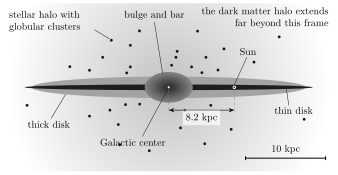
The bulge is the dense concentration of mostly old stars in the inner 2 kpc. Infrared star counts, which get through the dust, show that it is elongated: the Milky Way is a barred spiral, with a bar about 5 kpc in half-length. At the center sits Sagittarius A*, a black hole of \(4.3\times10^{6}\,\Msun\).
The stellar halo is a sparse, roughly spherical cloud of old stars around everything else. It includes about 160 globular clusters and holds around 1% of the Galaxy’s stars. Halo stars do not take part in the rotation of the disk. Their orbits are elongated and point in all directions, so the few that happen to be crossing the solar neighborhood pass us at 200 to 300 km/s.
| Component | Extent | Mass (\(\Msun\)) | Stars |
|---|---|---|---|
| Thin disk | \(h \approx 300\unit{pc}\) | \(3.5\times10^{10}\) | all ages, metal rich |
| Thick disk | \(h \approx 900\unit{pc}\) | \(6\times10^{9}\) | older than 8 Gyr |
| Bulge and bar | inner 2 to 5 kpc | \(1.5\times10^{10}\) | mostly older than 10 Gyr |
| Stellar halo | beyond 100 kpc | \(10^{9}\) | oldest, metal poor |
| Dark matter halo | about 200 kpc | \(10^{12}\) | none |
1.3 Stellar populations
In 1943 Walter Baade, helped by the wartime blackout of Los Angeles below Mount Wilson, resolved the center of the Andromeda galaxy into single stars. Its brightest stars were red giants, while those of the spiral arms were blue supergiants, and Baade concluded that galaxies contain two kinds of stellar population. Population I is the disk: stars of all ages on nearly circular orbits, with a chemical composition like the Sun’s. Population II is the halo with its globular clusters: old stars on elongated orbits, poor in heavy elements.
The chemical difference is measured by the metallicity \[ [\mathrm{Fe/H}] = \log_{10}\left(\frac{N_{\mathrm{Fe}}}{N_{\mathrm{H}}}\right)_{\mathrm{star}} - \log_{10}\left(\frac{N_{\mathrm{Fe}}}{N_{\mathrm{H}}}\right)_{\odot}, \] where \(N_{\mathrm{Fe}}/N_{\mathrm{H}}\) is the number of iron atoms per hydrogen atom, read from the absorption lines of the star. The Sun has \([\mathrm{Fe/H}] = 0\) by definition, and a star with \([\mathrm{Fe/H}] = -2\) has one hundredth of the Sun’s iron per hydrogen atom. Thin disk stars lie between about \(-0.5\) and \(+0.3\). Halo stars are mostly below \(-1\), and a handful are below \(-5\) (Unit 9 follows those).
Age, chemistry and orbit are linked through the enrichment history of Unit 7. The first generations of stars formed from nearly pristine hydrogen and helium, before the gas had settled into a rotating disk. Later generations formed inside the disk, from gas enriched by earlier stars, and inherited its circular motion. Orbits keep this record for billions of years, because stars are so far apart that they practically never deflect one another. A group of stars that fell into the Milky Way together, as a small galaxy, stays on similar orbits long after tides have pulled the galaxy apart. By searching the Gaia catalog for such groups and checking their chemistry, Amina Helmi and colleagues showed in 2018 that most stars of the inner halo are the debris of one galaxy, Gaia-Enceladus. It merged with the Milky Way about 10 billion years ago and stirred up the young disk, which contributed to the thick disk seen today.