Light, Radiation and Spectra
Almost all astronomical knowledge comes from light. This unit explains how brightness is measured and turned into distance, how the color of a star gives its temperature, and how the lines in a spectrum reveal composition, motion and physical conditions. With these tools a point of light becomes a star with a known size, temperature and velocity.
1 Waves and photons
Light is a wave of electric and magnetic fields that crosses empty space at \(c = 2.998\times10^{8}\unit{m\,s^{-1}}\). Nearly everything in the later units was read out of such waves, because the alternative, flying an instrument to the source, has so far worked only inside the solar system.
The wavelength \(\lambda\) is the distance between two neighboring crests of the wave. The frequency \(f\) is the number of crests that pass a fixed point each second, measured in hertz. In one second the wave advances by \(f\) wavelengths, so \(c = \lambda f\). Green light with \(\lambda = 550\unit{nm}\) has \(f = 5.45\times10^{14}\unit{Hz}\). An FM radio station at \(100\unit{MHz}\) sends out waves \(3.00\unit{m}\) long.
Light delivers its energy in indivisible portions called photons. A photon of frequency \(f\) carries the energy \begin{equation} E = hf = \frac{hc}{\lambda} , \label{eq:photon} \end{equation} where \(h = 6.626\times10^{-34}\unit{J\,s}\) is Planck’s constant. The customary unit is the electronvolt, \(1\unit{eV} = 1.602\times10^{-19}\unit{J}\). In these units \(hc = 1240\unit{eV\,nm}\) and the conversion becomes a single division. A \(550\unit{nm}\) photon carries \(1240/550 = 2.25\unit{eV}\), and an X-ray photon of \(1\unit{keV}\) has a wavelength of \(1.24\unit{nm}\). The photon picture is needed whenever light meets matter, since an atom absorbs or emits one photon at a time (Section 4).
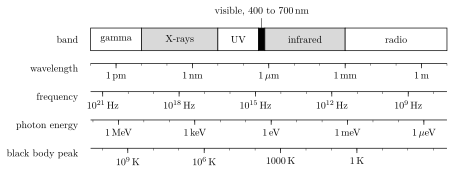
Visible light covers wavelengths between \(400\unit{nm}\) (violet) and \(700\unit{nm}\) (red), less than a factor of two. Astronomers observe over more than twenty powers of ten, with gamma-ray photons of \(10^{12}\unit{eV}\) at one end and radio waves tens of meters long at the other. The band names in Figure 1 are historical and their borders are conventions.
The bottom scale of the figure shows why all bands are needed. Matter at temperature \(T\) radiates most strongly at a wavelength inversely proportional to \(T\). Dust clouds at \(20\unit{K}\) glow in the far infrared and the gas in a galaxy cluster, at tens of millions of kelvin, emits X-rays, with the stars in between. Unit 4 describes the telescopes for each band.