Image: ALMA (ESO/NAOJ/NRAO), S. Andrews et al.; NRAO/AUI/NSF, S. Dagnello
More than 6000 planets are known around other stars, almost all of them found without ever being seen. This unit explains the five detection methods with their formulas and blind spots, what the planet population looks like, how JWST reads the gases in a planet's atmosphere during a transit, and what would count as evidence of life.
Preview: the beginning of the unit
1 Radial velocities and astrometry
The star 51 Pegasi, a near twin of the Sun 15.5 pc away, moves toward us and away from us at \(56\unit{m\,s^{-1}}\) and repeats the cycle every 4.23 days. Michel Mayor and Didier Queloz reported this in October 1995 and explained it with a planet of half Jupiter’s mass on an orbit seven times smaller than Mercury’s, the first planet found around a star like the Sun. In October 2026 the NASA Exoplanet Archive lists 6375 confirmed planets. Fewer than a hundred have been seen as a point of light. Jupiter reflects only \(4\times10^{-9}\) of the Sun’s light and from 10 pc would sit half an arcsecond from it, so most methods leave the planet alone and measure the star: its velocity, its position or its brightness.
1.1 The reflex motion of a star
Two bodies orbit their common center of mass (Unit 2). A star of mass \(M_*\) and a planet of mass \(M_p\) sit on opposite sides of it at distances that satisfy \(M_* a_* = M_p a_p\), and since both take the same time \(P\) for one orbit, their speeds have the same ratio: \(v_* = (M_p/M_*)\,v_p\). Jupiter travels at \(13.1\unit{km\,s^{-1}}\) and the Sun is 1047 times more massive, so the Sun circles the center of mass at \(12.5\unit{m\,s^{-1}}\), the top speed of an Olympic sprinter. The Earth moves the Sun by \(9\unit{cm\,s^{-1}}\).
The part of this motion along the line of sight shifts the star’s spectral lines by the Doppler effect (Unit 3), \(\Delta\lambda/\lambda = v_r/c\). For 51 Pegasi the shift is \(1.9\times10^{-7}\), about one hundredth of the width of a line, so a planet-hunting spectrograph (Unit 4) records thousands of lines at once against a stable wavelength reference and averages. HARPS at La Silla has held a precision below \(1\unit{m\,s^{-1}}\) since 2003. The stars are now the limit: convection and spots shift the lines by about \(1\unit{m\,s^{-1}}\) on their own, which is why no Earth twin has been found this way.
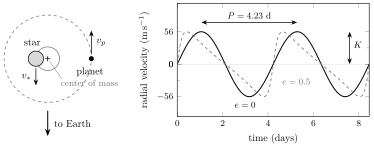
Figure 1. Left: star and planet orbit their center of mass (the star’s orbit is enlarged). Right: the radial velocity of 51 Pegasi computed from its orbit, with period \(P = 4.23\) d and semi-amplitude \(K = 56\unit{m\,s^{-1}}\) (solid). The dashed curve has the same \(P\) and \(K\) but an eccentricity of 0.5.
The period and the eccentricity follow from the shape of the velocity curve (Figure 1), \(K\) from its height, and the mass of the star from its spectral type (Unit 6). What remains is \(M_p \sin i\) with the inclination unknown, so the method gives a minimum mass. For randomly oriented orbits the chance that \(\sin i < 0.5\) is 13%, so the true mass is rarely more than twice the minimum. Since \(K \propto M_p P^{-1/3}\), and at least one full orbit must be covered, heavy planets on short orbits are found first. A copy of Jupiter needs twelve years of stable measurements.
1.2 Astrometry
The same reflex orbit can be measured as a small ellipse that the star traces on the sky. Its angular semi-major axis is
\[
\alpha = \frac{M_p}{M_*}\,\frac{a}{d} ,
\]
in arcseconds when the planet’s semi-major axis \(a\) is in au and the distance \(d\) in parsecs. Jupiter and the Sun seen from 10 pc give 0.5 milliarcseconds. The signal grows with the size of the orbit, the opposite of the radial velocity signal, and there is no \(\sin i\) ambiguity. It takes years of positions good to tens of microarcseconds, which only Gaia (Unit 4) has delivered. The archive credits astrometry with six planets so far. Gaia’s fourth data release, scheduled for December 2026, will contain the individual position measurements for the first time, and forecasts expect thousands of giant planets from them.
The full unit is part of the program
Want to see a complete unit first? Unit 5, The Solar System, is free to read.